In the thick of the campaign, the American Institute of Architects invited the eleven major candidates for mayor of San Francisco to debate their respective visions for the City by the Bay.


When the topics of density, smart growth, and sustainability came up, "each candidate except Hall was supportive but offered no specifics about what dense development might look like," reports George Calys. Dennis Herrera thought "balance" was the answer; who could argue with that?
"Mayor Ed Lee did tie density to workforce housing, the political euphemism for middle class home ownership in San Francisco, but didn't reveal exactly how he'd go about creating it. All the candidates liked the idea of making mid-Market a more vibrant area, but whether tax breaks for businesses in the area (as Mayor Lee achieved earlier this year) or creating an arts district were the answers, no one really seemed to have much to offer."
Read the full story: Of mice and mayors: San Francisco candidates thin on urban vision

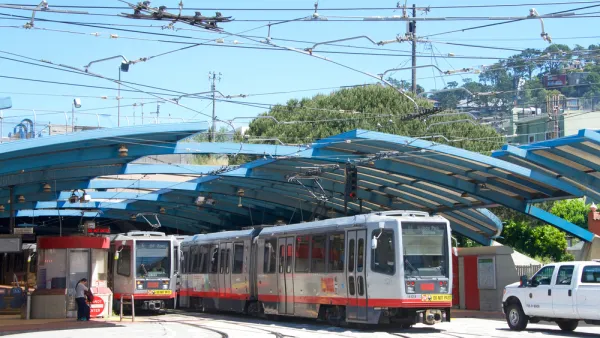
Planning a New Subway to San Francisco's 'Sleepy' West Side
San Francisco is planning for new population growth and new housing developments on the West Side of the city, and is also expecting high quality public transit to fill the mobility needs of current and future residents.
New Development Projects Boost San Francisco's Northern Waterfront
The historic Fort Mason, along with several other development projects, has helped alter the landscape of the city’s northern waterfront, according to Jim Chappell, former head of the San Francisco Planning and Urban Research Association.
Sacramento Outsmarts San Francisco, L.A.
Residents of San Francisco and Los Angeles like to feel superior to supposedly unsophisticated Sacramento. Yet, Sacramento appears to be ahead of the hip coastal areas when it comes to actually implementing smart growth.

Planetizen Federal Action Tracker
A weekly monitor of how Trump’s orders and actions are impacting planners and planning in America.

Amtrak, CN end decades-long dispute with eight-year agreement
The new operating agreement establishes an updated framework for the companies to work together, including processes to resolve disputes.

Northwest rail fans eager for Sept. 30 debut of Amtrak’s Airo fleet
Get ready for that new train smell and more seats. But they won’t go faster or run more frequently on the Cascades route in Washington and Oregon.

Trump administration unlawfully slashed $7 billion in clean energy grants, judge rules
The Environmental Protection Agency ended the Solar For All program, which provided the grants, after President Donald Trump’s inauguration.

Record-breaking wildlife overpass in Colorado brings 91% reduction in animal collisions
Prior to the overpass, vehicles were hitting one deer per day on Colorado’s Interstate 25.

California lawmakers approve just 5% of much-needed LA28 transportation funding
State legislators appear just as unwilling as Trump to pay for Olympics-related transportation projects.

FREE Course: Walkable City 1: Why Walkability?
After describing his path towards focusing on walkability as the essence of good planning, Jeff Speck marches through his five principal reasons for making more walkable places.
Reinventing Malls: Planning Alchemy—Turning Gray Fields Into Gold
The course focuses on the opportunities and imperatives that shape reinvention of mall sites.

City of Thousand Oaks
City of Wisconsin Rapids
Harvard University Graduate School of Design
The Architects Foundation
University of Cincinnati Online
The Pocatello Development Authority
The Urban Renewal Agency of the City of Pocatello