Starting in 2002, the Colorado legislature began to make it easier to foreclose on properties in Colorado. Original loan documents are no longer required to prove the bank actually owns the property.


As the practice of buying and selling mortgages increased from 2002 to 2008, the Colorado legislature and public trustees were looking for ways to make the foreclosure practice simpler, says Migoya.
"The changes meant banks no longer had to provide original documents at a foreclosure, just affidavits from lawyers saying the bank owned the notes and got them legally."
"Others say the foreclosure process has become so heavily weighted in favor of lenders and their lawyers - much of it with the help of the trustees - that homeowners stand little chance of finding fairness in a system that's supposed to ensure equal justice."
According to Migoya, Colorado has a unique system that puts the foreclosure process into the hands of public trustees, rather than the courts. He says the changes were intended to streamline the foreclosure process and make it easier for homeowners to protect their property.
Thanks to Cathie Pagano
Read the full story: Colorado public trustees pushed to make it easier to foreclose on homes

Banks Exacerbating Foreclosure Crisis
Banks and financial institutions are making the foreclosure crisis worse, as lobbying efforts seek to block bankruptcy courts from gaining more power to reduce debt, according to this article from Der Spiegel.

'Seriously Delinquent' Mortgages Explode, But Don't Expect a Great Recession-Style Meltdown
More and more homeowners are falling behind on mortgage payments as the pandemic lingers, according to recent market data.
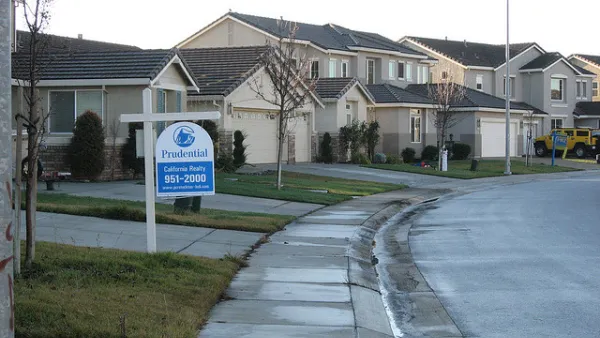
Foreclosures Near 20-Year Low
Some areas of the country are experiencing stress in the housing market, according to the new CoreLogic "Loan Performance Insights" report, but overall it's a long-time since homeowners have been so stable.

Planetizen Federal Action Tracker
A weekly monitor of how Trump’s orders and actions are impacting planners and planning in America.

California plans to bury El Niño’s downpour
If the state plays its cards right, it may be able to store a billion acre-feet of El Niño’s water in aquifers.

Chicago breaks ground on $3 billion megadevelopment
The new neighborhood, titled Foundry Park, will one day host 3,700 residences.

California High-Speed Rail Authority CEO resigns after $600,000 scandal
Under Ian Choudri, the authority used taxpayer dollars to fund first class flights and trips to nightclubs.

Want to study the Missouri River? Soon, you may need unanimous approval from 10 states
Legislation would require 10 governors’ permission to study or build projects moving water outside the basin.

Desperate measures: Advocates weigh draining Lake Powell to fill Colorado River
Draining the reservoir could reduce evaporation losses by a couple hundred thousand acre-feet.

FREE Course: Walkable City 1: Why Walkability?
After describing his path towards focusing on walkability as the essence of good planning, Jeff Speck marches through his five principal reasons for making more walkable places.
Reinventing Malls: Planning Alchemy—Turning Gray Fields Into Gold
The course focuses on the opportunities and imperatives that shape reinvention of mall sites.

City of Rosemead
Rutgers University, Edward J. Bloustein School of Planning and Public Policy
One Hundred Miles
Hunter College, City University of New York (CUNY)
The Architects Foundation
University of Cincinnati Online
City of Cambridge
Montrose County
The Pocatello Development Authority