The immense drill that's burrowing a subway tunnel beneath New York City will remain underground after its work is through, a move to cut the expensive costs of removing it.


The 200-ton drill will remain 14 stories below the surface of the earth.
"A recent visit to the cutter's future crypt revealed a machine that evokes an alien life form that crashed to earth a millennia ago. Its steel gears, bolts and pistons, already oxidizing, appeared lifeless and fatigued. A wormlike fan, its exhaust pipe disappearing into the cutter's maw, was still spinning, its drone not unlike a slumbering creature's breath.
"If you came and visited this 100 years from today, this is what you'd see," said Dr. Horodniceanu, balancing on a catwalk that overlooks the enormous contraption. "People would not know what it's all about."
The cutter head, known as Seli after its Italian manufacturer, has been eating its way through several miles of Manhattan schist since 2007. Its flat face is equipped with 45 rotating discs, each carrying a layer of tungsten carbide, an exceptionally strong alloy that can easily break through the city's bedrock. (Rumors that the machine used diamonds for this purpose were "an urban legend," according to a transportation authority spokesman.)"
Read the full story: Deep Below Park Avenue, a Monster at Rest
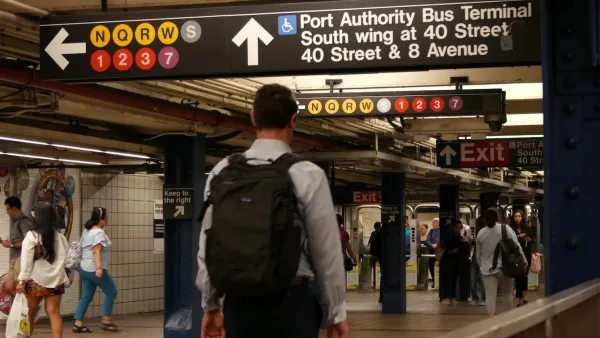
MTA looks to bring AI-assisted, multilingual announcement system to subways
Some of the transit agency’s audio systems haven’t been upgraded in 40 years.
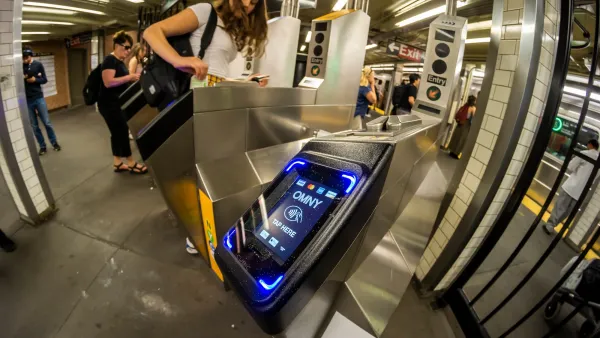
Popular transit payment system linked to Palantir could give ICE access to rider data
The tap-to-pay system is being used widely in transit systems including New York City, Boston and Chicago.
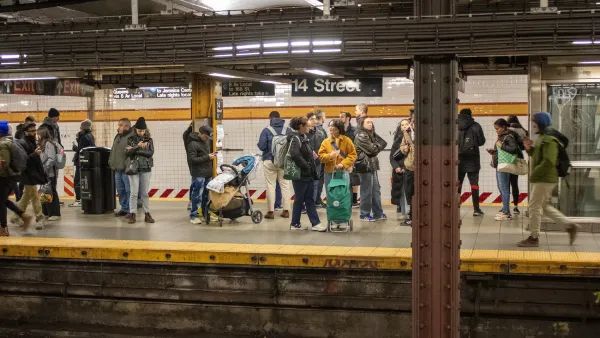
Report: Expanding MTA Fair Fares subway program would benefit New Yorkers more than free buses
A report from the city's Citizens Budget Commission recommends subsidizing fares for more low-income subway riders rather than making buses free for everyone.

Planetizen Federal Action Tracker
A weekly monitor of how Trump’s orders and actions are impacting planners and planning in America.

California plans to bury El Niño’s downpour
If the state plays its cards right, it may be able to store a billion acre-feet of El Niño’s water in aquifers.

Desperate measures: Advocates weigh draining Lake Powell to fill Colorado River
Draining the reservoir could reduce evaporation losses by a couple hundred thousand acre-feet.

Los Angeles just elected an urban planner as its mayor
Transportation analysts are optimistic that Raman will be more aggressive in addressing transit issues than Bass.

Mamdani’s pied-à-terre tax survives legal challenge
A panel of judges found that the plaintiffs failed to demonstrate injury as a result of New York City's implementation of the tax.

Eastern Nebraska is running out of electricity
Data centers and electrification are straining eastern Nebraska’s grid, throttling economic development.

FREE Course: Walkable City 1: Why Walkability?
After describing his path towards focusing on walkability as the essence of good planning, Jeff Speck marches through his five principal reasons for making more walkable places.
Reinventing Malls: Planning Alchemy—Turning Gray Fields Into Gold
The course focuses on the opportunities and imperatives that shape reinvention of mall sites.

City of Rosemead
Rutgers University, Edward J. Bloustein School of Planning and Public Policy
One Hundred Miles
University of Michigan School for Environment and Sustainability (SEAS)
Hunter College, City University of New York (CUNY)
The Architects Foundation
City of Cambridge
Montrose County
The Pocatello Development Authority