Patrick Kennedy stresses the importance of quality over quantity in residential housing by comparing houses in McKinney, North Texas, with those on Swiss Avenue near Downtown Dallas.


Kennedy discovers that home value in sprawling McKinney tanked by as much as 44% whereas those on Swiss Avenue "averaged a 10 percent increase in value since the housing peak in 2008."
Claiming that build quality, more or less, contributes to the disparity, Kennedy writes:
"[I]n order to get houses up in three months rather than 12 to 18, builders use stock plans without giving much thought to layout. Rooms are huge because that means fewer walls, and walls cost money. The lumber is full of knots, and it's softer than the old-growth timbers that were used to build houses 50 or 100 years ago. The result is that much of the tract housing stock in our exurbs won't be standing in 30 years."
"I'm afraid many exurban neighborhoods [...] face an uncertain future against shifting demographics looking to downsize," he adds.
Read the full story: Why Homes in the Exurbs Aren't Built to Last

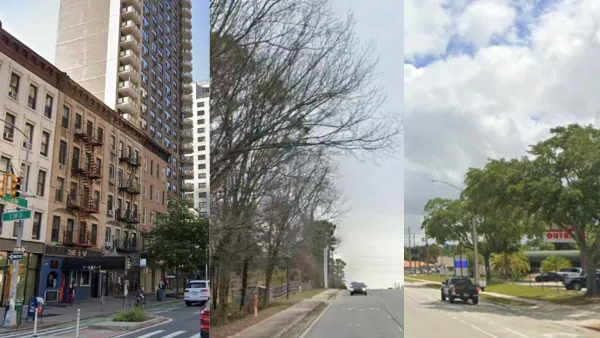
A Transect of sprawl
A development pattern this lifestyle-defining deserves its whole own classification system.

What the fall of earth's largest pre-industrial city can teach us about urban sprawl
Angkor was a low-density metropolis. It lasted six centuries, until it could no longer maintain its infrastructure in a changing climate. Today, it offers planners a sobering warning about the risks of dispersed urban living.

Nearly a third of US housing is in the wildland-urban interface — and at growing risk of wildfire
As suburbs increasingly mingle with undeveloped land, homes face a higher risk from destructive fires.

Planetizen Federal Action Tracker
A weekly monitor of how Trump’s orders and actions are impacting planners and planning in America.

Amtrak, CN end decades-long dispute with eight-year agreement
The new operating agreement establishes an updated framework for the companies to work together, including processes to resolve disputes.

Northwest rail fans eager for Sept. 30 debut of Amtrak’s Airo fleet
Get ready for that new train smell and more seats. But they won’t go faster or run more frequently on the Cascades route in Washington and Oregon.

NYC to turn city-owned property into thousands of homes
The city has scheduled a public hearing regarding the development for October.

Buses travel at 5mph along this route in NYC. The Bronx's first-ever busway looks to change that
Prior to the busway, buses on the Bx36 route traveled as slowly as 5 miles per hour.

Pittsburg launches 'EZ permits,' aims for one-day turnaround for low-risk permits
The pilot ‘fast lane’ for permits is part of a bundle of modernization efforts for Pittsburg’s permitting process.

FREE Course: Walkable City 1: Why Walkability?
After describing his path towards focusing on walkability as the essence of good planning, Jeff Speck marches through his five principal reasons for making more walkable places.
Reinventing Malls: Planning Alchemy—Turning Gray Fields Into Gold
The course focuses on the opportunities and imperatives that shape reinvention of mall sites.

City of Thousand Oaks
City of Wisconsin Rapids
Harvard University Graduate School of Design
The Architects Foundation
University of Cincinnati Online
The Pocatello Development Authority
The Urban Renewal Agency of the City of Pocatello