Dan Leavitt, California High-Speed Rail Authority’s deputy director, says Calif. can either be at the whim of 'market-driven sprawl,' or high-speed rail can revolutionize the state. Yet, arguments for getting people to ride rail are contentious.


An empty train caring only seats expends close to the same amount of energy as a single-occupancy car, or low occupancy plane, reports Saquib Rahim, Climate Wire reporter who's story was published in The New York Times.
"A packed train, on the other hand, moves its riders more efficiently than a car or plane can.
"And the authority is counting on its trains to be packed.
"By 2030, it projects, 88 million to 117 million passengers will ride the system each year. If a high-speed train didn't exist, Californians would take 33 million flights that year; with the train available, they would take 21 million."
Read the full story: Who Will Ride an Alternative to 'Market-Driven Sprawl'?

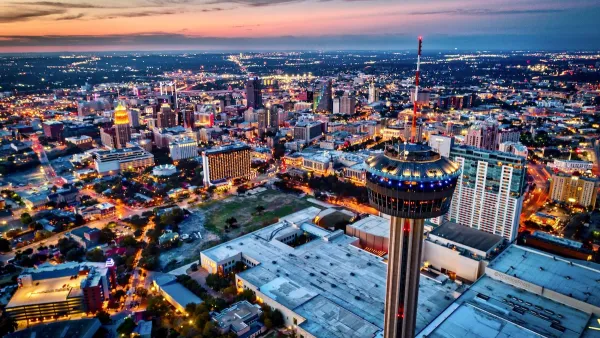
San Antonio and Austin are Fusing Into one Massive Megaregion
The region spanning the two central Texas cities is growing fast, posing challenges for local infrastructure and water supplies.

What the fall of earth's largest pre-industrial city can teach us about urban sprawl
Angkor was a low-density metropolis. It lasted six centuries, until it could no longer maintain its infrastructure in a changing climate. Today, it offers planners a sobering warning about the risks of dispersed urban living.

Nearly a third of US housing is in the wildland-urban interface — and at growing risk of wildfire
As suburbs increasingly mingle with undeveloped land, homes face a higher risk from destructive fires.

Planetizen Federal Action Tracker
A weekly monitor of how Trump’s orders and actions are impacting planners and planning in America.

Amtrak, CN end decades-long dispute with eight-year agreement
The new operating agreement establishes an updated framework for the companies to work together, including processes to resolve disputes.

Judges permit Denver to divert 77,000 acre feet from the Colorado River for reservoir expansion
Overuse and climate change have caused the Colorado River’s water levels to plummet.

South Chicago development proposal would 'upzone' neighborhoods to increase density
The South Chicago Land Use Framework plan also aims to promote pedestrian and transit-oriented developments.

Boston has spent millions making the Green Line more accessible — and there’s no end in sight
While the city has invested millions into expanding and adding platforms to the Green Line to make it more accessible, new train cars set to arrive next year will be too tall for disabled passengers to board without raising the current platforms.

Idaho may see an 18% drop in federal surface transit funding — the largest estimated cut in the US
Transit systems in rural communities are much more reliant on federal funding to provide their services.

FREE Course: Walkable City 1: Why Walkability?
After describing his path towards focusing on walkability as the essence of good planning, Jeff Speck marches through his five principal reasons for making more walkable places.
Reinventing Malls: Planning Alchemy—Turning Gray Fields Into Gold
The course focuses on the opportunities and imperatives that shape reinvention of mall sites.

City of Wisconsin Rapids
Harvard University Graduate School of Design
KFH Group Inc.
The Architects Foundation
University of Cincinnati Online
The Pocatello Development Authority
The Urban Renewal Agency of the City of Pocatello