Though much of its urban form requires a car to traverse, a few new projects in Miami are shifting the city away from its past of parking lot sprawl.


"Miami is a city that has always inspired pride and envy for its core offers of escapism, partying, sunshine and sex, but until recently the quality of its urban and cultural environment lagged some way behind. A highly suburban car-based city, Miami's centres had been dominated by sprawling surface car parking lots and with some exceptions Miami's contemporary architecture was nothing to write home about.
But now the city's credentials have been bolstered by a roster of fine new buildings, some fantastic public space and an array of cultural facilities with more in the pipeline. Given the quality and coherence of these elements, it does not seem overstated to describe what is happening as an 'urban renaissance'."
A new cinema, a small-scale bike sharing system and even a new take on the parking structure are showing how the city is in the midst of a shift in its physical form.
Read the full story: Miami's Urban Renaissance
Living the Parking Lot Lifestyle
Swiss architectural firm Herzog & de Meuron have designed a new parking garage for Miami that attempt to engage the public with a shockingly open-air design.
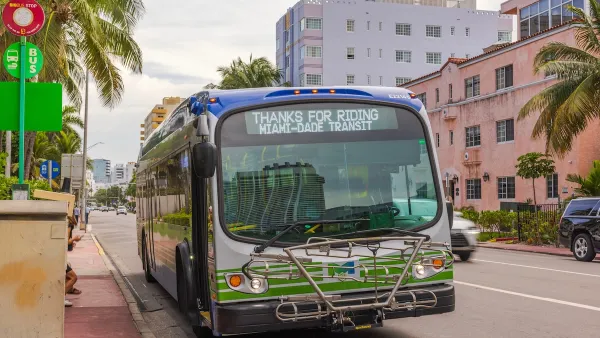
More money, less service: Miami-Dade slashes bus routes after hiking fare
The department is facing a multi-million dollar funding gap.

Children in 55 countries are redesigning their cities in Minecraft
A U.N.-backed program lets students and community members reimagine sites in their neighborhoods in the game — and translate them into real-life buildings.

Planetizen Federal Action Tracker
A weekly monitor of how Trump’s orders and actions are impacting planners and planning in America.

California plans to bury El Niño’s downpour
If the state plays its cards right, it may be able to store a billion acre-feet of El Niño’s water in aquifers.

Desperate measures: Advocates weigh draining Lake Powell to fill Colorado River
Draining the reservoir could reduce evaporation losses by a couple hundred thousand acre-feet.

In Texas, data centers are swallowing promised parkland
Residents who moved to Taylor, Texas for a rural community now have to contend with three data centers in their backyard.

How a Chicago-sized wind farm beat the odds and powered on
The project spanned five presidential administrations and a standoff with a U.S. military base.

MTA gives itself 30 days to transform pit into basketball court
The site has been under construction since 2022; the city originally estimated it would finish the court in 2024.

FREE Course: Walkable City 1: Why Walkability?
After describing his path towards focusing on walkability as the essence of good planning, Jeff Speck marches through his five principal reasons for making more walkable places.
Reinventing Malls: Planning Alchemy—Turning Gray Fields Into Gold
The course focuses on the opportunities and imperatives that shape reinvention of mall sites.

City of Rosemead
Rutgers University, Edward J. Bloustein School of Planning and Public Policy
One Hundred Miles
Hunter College, City University of New York (CUNY)
The Architects Foundation
University of Cincinnati Online
City of Cambridge
Montrose County
The Pocatello Development Authority