An accident-prone section of bike path in Seattle has prompted dozens of lawsuits and resulted in hundreds of thousands of dollars in payments to injured cyclists. Now the cyclists themselves are trying to fix the infrastructural problem.


A group of seven cyclists who have won rewards are pooling some money to pay a traffic engineer to address the problem.
"[A] bicyclist falls there daily. That's the estimate of Cliff Valentine, of AMC Cliffv's Marine Service, whose office looks out on the tracks. Bike wrecks are so constant he keeps a first-aid kit at his front door.
Most of the falls are minor. But lawyers suing the city found that 66 times in the past decade the injuries were bad enough to call out the Fire Department.
Still, the city hasn't done much beyond striping the pavement to encourage cyclists to cross the tracks at a right angle (the roadway meets them at a 20-degree angle.)"
Read the full story: City needs to get in gear over offer from injured bicyclists
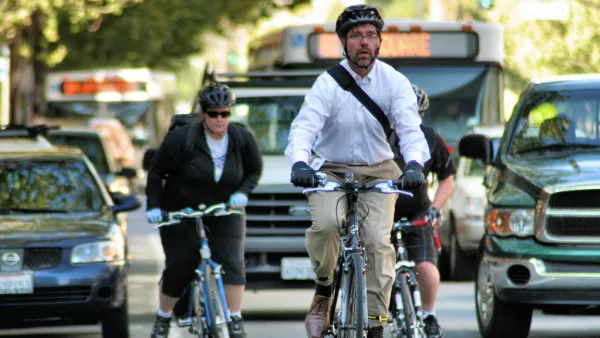
When Cyclists Break Traffic Laws for Their Own Safety
A study examines whether and why bicyclists break traffic laws to shed light on how rational those laws really are.
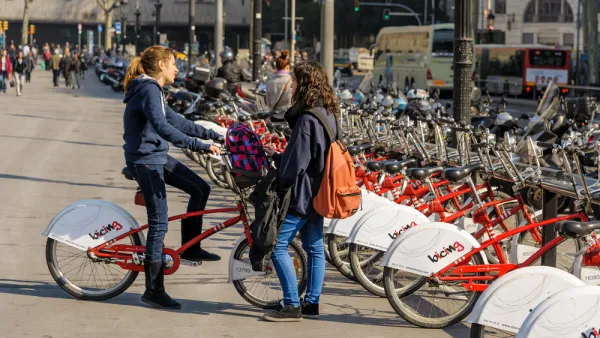
Report: Bikeshare Makes Biking Safer
In the United States, not a single bikeshare rider has died in an accident so far. A report from the Mineta Transportation Institute considers why bikeshare may be safer than conventional biking.
A Modest Proposal for Pedestrian-Cyclist Detente
The impending launch of bike-share is sure to escalate the simmering tensions between New York's growing legion of cyclists and its hordes of pedestrians. L.V. Anderson and Aisha Harris propose a 10-point treaty for pedestrian-cyclist armistice.

Desperate measures: Advocates weigh draining Lake Powell to fill Colorado River
Draining the reservoir could reduce evaporation losses by a couple hundred thousand acre-feet.

Eastern Nebraska is running out of electricity
Data centers and electrification are straining eastern Nebraska’s grid, throttling economic development.

Move over, LA: St. Louis gears up for Olympics, invests millions in downtown redevelopment
The Missouri city will host the 2028 Olympic soccer group stage and knockout matches.

Maryland’s $15 billion bridge project gains key approval
The Maryland Transit Authority said the project will create over 60,000 jobs and add $23 billion to the local economy.

‘No clear next steps’ for Chicago's permanent festival grounds
Eleventh Ward Ald. Nicole Lee has suggested Soldier Field as a possible location for the permanent event space.

California, Hawaii, Rhode Island approve housing propositions
Hawaii and Rhode Island each approved their sole proposition, while California approved two of its three.

FREE Course: Walkable City 1: Why Walkability?
After describing his path towards focusing on walkability as the essence of good planning, Jeff Speck marches through his five principal reasons for making more walkable places.
Reinventing Malls: Planning Alchemy—Turning Gray Fields Into Gold
The course focuses on the opportunities and imperatives that shape reinvention of mall sites.

City of Rosemead
Rutgers University, Edward J. Bloustein School of Planning and Public Policy
One Hundred Miles
University of Michigan School for Environment and Sustainability (SEAS)
Hunter College, City University of New York (CUNY)
The Architects Foundation
City of Cambridge
Montrose County
The Pocatello Development Authority