The U.S. Department of Housing and Urban Development (HUD) claims that Obama's economic stimulus bill helped contain the number of homeless people in 2009 and 2010.


Other leading economic indicators like Wall Street, GDP, unemployment rate, and CPI notwithstanding, The American Recovery and Reinvestment Act (ARRA) "does appear to have unambiguously succeeded [because] it kept the number of homeless people from soaring," reports Shawn Zeller.
With $1.5 billion direct funding from the stimulus bill, "the states were able to find housing for 531,000 people at risk of becoming homeless, while 159,000 were moved from the streets into homes."
"[H]ad it not been for President Obama's Recovery Act, many hundreds of thousands of persons may have fallen into homelessness," says HUD Secretary Shaun Donovan in the article.
The rest of $787 billion ARRA money went to rescue too-big-to-fail institutions in order to prevent a systematic collapse of the U.S. financial system.
Read the full story: A Stimulus Success Story


U.S. Supreme Court Upholds Camping Bans, but Challenges of Addressing Homelessness Remain
In Grants Pass v. Johnson, the Supreme Court upheld an Oregon city’s ban on camping in public places, paving the way for similar bans in cities across the country but doing nothing to solve the cause of homelessness.

Sweeps Aren’t Outreach: Policing Homelessness Still Doesn’t Work
A new study shines a light on the connection between homeless outreach teams and policing, and examines why so many cities still use resident complaints to guide their response to the homelessness crisis.
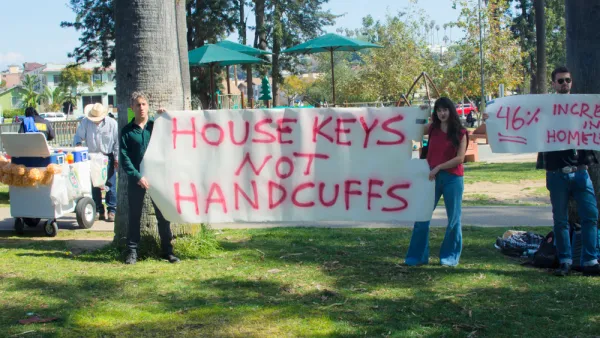
Los Angeles Tightens Restrictions on Encampments
During a city council meeting that had to pause while police cleared the room of activists opposing the measure, the council voted to ban public sleeping within 500 feet of schools, making one-fifth of city sidewalks off-limits to unhoused people.

Planetizen Federal Action Tracker
A weekly monitor of how Trump’s orders and actions are impacting planners and planning in America.

Amtrak, CN end decades-long dispute with eight-year agreement
The new operating agreement establishes an updated framework for the companies to work together, including processes to resolve disputes.

Northwest rail fans eager for Sept. 30 debut of Amtrak’s Airo fleet
Get ready for that new train smell and more seats. But they won’t go faster or run more frequently on the Cascades route in Washington and Oregon.

NYC to turn city-owned property into thousands of homes
The city has scheduled a public hearing regarding the development for October.

Buses travel at 5mph along this route in NYC. The Bronx's first-ever busway looks to change that
Prior to the busway, buses on the Bx36 route traveled as slowly as 5 miles per hour.

Pittsburg launches 'EZ permits,' aims for one-day turnaround for low-risk permits
The pilot ‘fast lane’ for permits is part of a bundle of modernization efforts for Pittsburg’s permitting process.

FREE Course: Walkable City 1: Why Walkability?
After describing his path towards focusing on walkability as the essence of good planning, Jeff Speck marches through his five principal reasons for making more walkable places.
Reinventing Malls: Planning Alchemy—Turning Gray Fields Into Gold
The course focuses on the opportunities and imperatives that shape reinvention of mall sites.

City of Thousand Oaks
City of Wisconsin Rapids
Harvard University Graduate School of Design
The Architects Foundation
University of Cincinnati Online
The Pocatello Development Authority
The Urban Renewal Agency of the City of Pocatello