This piece from Domus goes on a tour of Athens with local architect Andreas Angelidakis, who reflects on the city's lasting and negative impacts from hosting the Olympics.


The city was left with deep debt and many physical event venues that have been unable to stay in use.
"Angelidakis adds "this is exactly what I wanted to talk about, what the Olympic Games left the city." This takes us to the second stop on our journey after steering our way through deafening and nightmare traffic for about 20 minutes. We come to the port of Faliron Delta, the only area inside the walls of Ancient Athens that gave access to the port. Here, towering above crumbling, abandoned and overgrown buildings is a stadium, also abandoned but as colossal as the Stade de France and designed for beach volleyball.
'Beach volleyball? Why on earth build a concrete stadium for beach volleyball?' Andreas asks me, 'Do you see the need? These megastructures are closed and abandoned; they can't even be used for concerts or anything else so they are orphans of the city, dead. If they were, at least, open to the public they could become the modern ruins of Athens, at least people could visit them.'"
FULL STORY: The divided Athens of Andreas Angelidakis

Despite Expenses, Athens Enjoys Transit Legacy of 2004 Olympics
The 2004 Olympics in Athens burdened the city with underutilized venues and deep debt. But the event also vastly improved pedestrian and public transportation.
As Venues Sit Unused, Athens Feels Olympic Remorse
Four years after it hosted the Summer Olympics, Athens is questioning whether the $15 billion investment in venues that now largely sit unused was really worth it.
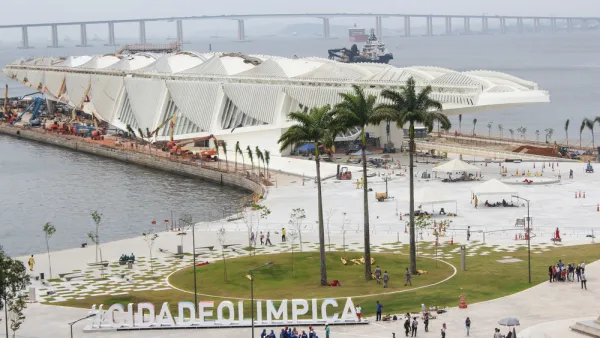
Abandoned Olympic Venues Cast Doubt on the Value of Hosting
Though cities hope for an economic boost, these photos show it's far from guaranteed.

The state-sanctioned urbicide of Austin
People don’t kill cities. Freeways do.

US to reduce Colorado River water deliveries to Mexico
A new Colorado Treaty amendment reduces Mexico’s Colorado River water allocation by 250,000 acre feet.

New Jersey’s second-largest city bans standalone data centers
Jersey City will continue to allow co-location facilities, such as those meant for research institutions that store their own data.

Amtrak not solely to blame for New Jersey commuter rail's unreliability, report finds
A new study from the Garden State Initiative found that NJ Transit’s budget grew 20% across a 4 year period, but reliability declined significantly over the same period.

EPA erases limits on planet-warming pollution from power plants
Under Monday’s plan, power plants would still have some limits on how much mercury, arsenic and other contaminants they can emit.

Phoenix announces new on-demand transit service, more frequent RAPID buses
Both new services will launch in October, and are part of Phoenix's Project Effective Access Solutions for Easing Congestion.

FREE Course: Walkable City 1: Why Walkability?
After describing his path towards focusing on walkability as the essence of good planning, Jeff Speck marches through his five principal reasons for making more walkable places.
Reinventing Malls: Planning Alchemy—Turning Gray Fields Into Gold
The course focuses on the opportunities and imperatives that shape reinvention of mall sites.

Eagle County Government
Harvard University Graduate School of Design
Nashville Planning Department
The Architects Foundation
University of Cincinnati Online
The Pocatello Development Authority
The Urban Renewal Agency of the City of Pocatello
Journal of the American Planning Association