Preparations for the World Cup and Olympics are displacing hundreds of families in Rio de Janeiro. One neighborhood next to a major stadium has been turned into a ghost town.


Few families remain in this favela, where hundreds of families have been forced to move out to allow for preparations for the sporting events.
"Since February, nearly all of the buildings surrounding Freitas's home have been levelled as part of work to revamp the city's infrastructure before the World Cup and the 2016 Olympic Games.
Redbrick shacks have been cracked open by earth-diggers. Streets are covered in a thick carpet of rubble, litter and twisted metal. By night, crack addicts squat in abandoned shacks, filling sitting rooms with empty bottles, filthy mattresses and crack pipes improvised from plastic cups. The stench of human excrement hangs in the air.
'It looks like you are in Iraq or Libya,' Freitas said, wading across mounds of debris that now encircle his home. 'I don't have any neighbours left. It's a ghost town.'"
Read the full story: Rio World Cup demolitions leave favela families trapped in ghost town

Mega-Events Take Toll on Brazil's Slum Dwellers
This op-ed from Al Jazeera looks at some of the negative ways preparations for the World Cup and Olympics are affecting the poor in Brazil.
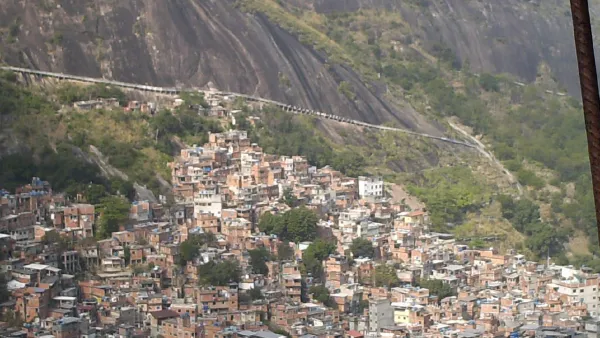
Rio's Pricey Sky Gondola Goes Full Stop
The sky gondola system built prior to the Rio Olympics has ground to a halt, leaving residents of the city's favelas with little to show for such a grand investment in infrastructure.
Re-Rio
With the next World Cup and the 2016 Summer Olympics on their way, Rio de Janeiro is in the midst of a vast citywide regeneration campaign.

Planetizen Federal Action Tracker
A weekly monitor of how Trump’s orders and actions are impacting planners and planning in America.

California plans to bury El Niño’s downpour
If the state plays its cards right, it may be able to store a billion acre-feet of El Niño’s water in aquifers.

Chicago breaks ground on $3 billion megadevelopment
The new neighborhood, titled Foundry Park, will one day host 3,700 residences.

Want to study the Missouri River? Soon, you may need unanimous approval from 10 states
Legislation would require 10 governors’ permission to study or build projects moving water outside the basin.

Desperate measures: Advocates weigh draining Lake Powell to fill Colorado River
Draining the reservoir could reduce evaporation losses by a couple hundred thousand acre-feet.

This road in NYC is infamously dangerous — and Mamdani can't fix it
New York City's Ocean Parkway is known for reckless driving, but the power to implement safety measures lies with the state rather than the city.

FREE Course: Walkable City 1: Why Walkability?
After describing his path towards focusing on walkability as the essence of good planning, Jeff Speck marches through his five principal reasons for making more walkable places.
Reinventing Malls: Planning Alchemy—Turning Gray Fields Into Gold
The course focuses on the opportunities and imperatives that shape reinvention of mall sites.

City of Rosemead
Rutgers University, Edward J. Bloustein School of Planning and Public Policy
One Hundred Miles
Hunter College, City University of New York (CUNY)
The Architects Foundation
University of Cincinnati Online
City of Cambridge
Montrose County
The Pocatello Development Authority