Urban-boosters in Cleveland and other Rust Belt locales are fierce defenders of their much-maligned cities. But does civic boosterism gloss over the region's very real problems? Worse, does it serve to protect the dysfunctional status quo?


Anne Schmitt writes that she's allergic to boosterism that glosses over a city's real problems:
"Here's the thing. I live in Cleveland. I have a good life. My neighbors are amazing. But I didn't grow up here. I didn't go to the public schools. 50,000 kids got to the Cleveland public schools. Only 54 percent of them graduate.
These statistics didn't come from Forbes. They are the reality of life in Cleveland. And life in Cleveland is very hard for many people whose prospects for the future may be very dim. I think we, even as urban boosters, need to acknowledge this.
I guess fundamentally, I think it is a bit disingenuous to ignore these glaring realities and claim without qualification that outsiders are wrong to point out Cleveland's dysfunction. Worse, even, I think this blind boosterism, this knee-jerk defensiveness, becomes a sort of defense of the status quo-and the status quo in Cleveland is indefensible."
Thanks to Angie Schmitt
Read the full story: The Problem with Boosterism

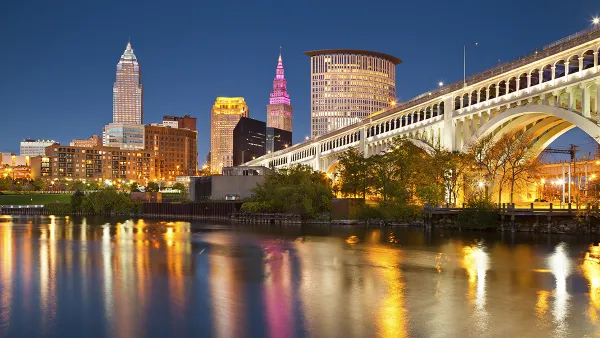
What 'Rust Belt Chic' Shows about the Complexity of Cities
Belt Magazine is publishing the second edition of its "Rust Belt Chic: The Cleveland Anthology" next month. The edition's new introduction sums up will the complicated issue of Cleveland's renaissance.
Economic Recovery in Legacy Cities
Americans living in legacy cities face a unique set of challenges and opportunities in recovering from the COVID-19 pandemic. Several local, state, and federal support strategies could aid these cities in recouping losses.

Report: Cleveland and Akron Showing Strength in the Heartland
While much of the news focuses on declining population and vacant homes, Cleveland and Akron have quietly outperformed many other cities on quality of life.

Planetizen Federal Action Tracker
A weekly monitor of how Trump’s orders and actions are impacting planners and planning in America.

California plans to bury El Niño’s downpour
If the state plays its cards right, it may be able to store a billion acre-feet of El Niño’s water in aquifers.

Desperate measures: Advocates weigh draining Lake Powell to fill Colorado River
Draining the reservoir could reduce evaporation losses by a couple hundred thousand acre-feet.

Non-stop party: Chicago voters weigh permanent festival grounds
A stable place for bleachers, stages and drainage may streamline the setup and teardown of large events.

Metra may invest $9.1 billion in regional rail
The agency released a draft of a study examining potential ways to offer more frequent train service.

California city breaks ground on transit connector
The project includes three mobility hubs and a pedestrian bridge.

FREE Course: Walkable City 1: Why Walkability?
After describing his path towards focusing on walkability as the essence of good planning, Jeff Speck marches through his five principal reasons for making more walkable places.
Reinventing Malls: Planning Alchemy—Turning Gray Fields Into Gold
The course focuses on the opportunities and imperatives that shape reinvention of mall sites.

City of Rosemead
Rutgers University, Edward J. Bloustein School of Planning and Public Policy
One Hundred Miles
Hunter College, City University of New York (CUNY)
The Architects Foundation
University of Cincinnati Online
City of Cambridge
Montrose County
The Pocatello Development Authority