Recently released plans for a possible new football stadium in downtown L.A. show how the city tends to react to developers rather than guide them, according to this criticism.


Los Angeles Times architecture critic Christopher Hawthorne discusses how the city time and again is in the position of responding to private plans for large-scale projects as opposed to setting guidelines of its own.
"Even as city planners have made a point of focusing, at least in theory, on a finer grain of civic improvements, such as urban-design guidelines released in 2009, in practice they continue to allow developers to shape downtown one mega-project at a time.
...Now, in South Park, Tim Leiweke, AEG's president and chief executive, has teamed with 36-year-old businessman Casey Wasserman on another high-stakes development gamble, in this case hoping a new retractable-roof stadium downtown will help lure the NFL back to Los Angeles. Though part of the site they have in mind - a 15-acre parcel between Staples Center and the Harbor Freeway - occupies city land, it was AEG, in private, that solicited design proposals from eight architecture firms, none of them particularly innovative. And it was AEG that trimmed that list of eight firms earlier this month to three."
Read the full story: Critic's Notebook: Los Angeles needs a game plan


The Arts District and the 'Missed Opportunity' of Planning in L.A.
Downtown L.A.'s Arts District transformed from an industrial sector to a vibrant, mixed-use neighborhood. Now, the community's attempts to protect their vision from haphazard development illuminate Los Angeles's broken planning process.
Downtown L.A. Stadium Plans Fall Flat
Proposed designs for a possible football stadium in downtown L.A. leave a lot to be desired -- both architecturally and urbanistically, according to this review.
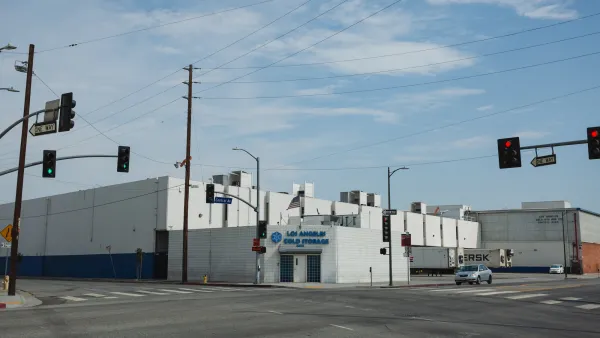
LA approves $2B 'urban village' plan for former cold storage facilities
The project promises an interconnected neighborhood with a focus on public space.

Planetizen Federal Action Tracker
A weekly monitor of how Trump’s orders and actions are impacting planners and planning in America.

California plans to bury El Niño’s downpour
If the state plays its cards right, it may be able to store a billion acre-feet of El Niño’s water in aquifers.

Chicago breaks ground on $3 billion megadevelopment
The new neighborhood, titled Foundry Park, will one day host 3,700 residences.

This road in NYC is infamously dangerous — and Mamdani can't fix it
New York City's Ocean Parkway is known for reckless driving, but the power to implement safety measures lies with the state rather than the city.

One of Denver’s busiest corridors to gain BRT
The project will span 18 miles and contain 74 bus rapid transit stations.

275,000 bus trips are at stake on Seattle's ballot
If passed, the Seattle Transit Measure would trigger a 0.3% sales tax and raise an average of $138 million per year to maintain and expand Seattle’s bus services.

FREE Course: Walkable City 1: Why Walkability?
After describing his path towards focusing on walkability as the essence of good planning, Jeff Speck marches through his five principal reasons for making more walkable places.
Reinventing Malls: Planning Alchemy—Turning Gray Fields Into Gold
The course focuses on the opportunities and imperatives that shape reinvention of mall sites.

City of Rosemead
Rutgers University, Edward J. Bloustein School of Planning and Public Policy
One Hundred Miles
Hunter College, City University of New York (CUNY)
The Architects Foundation
University of Cincinnati Online
City of Cambridge
Montrose County
The Pocatello Development Authority