Officials in Indonesia are increasingly considering a plan to relocate the capital from Jakarta to another, less troubled location.


Many there see the city as being overcrowded and ill-equipped to continue to function.
"It is the world's largest city without an underground transport system. Some 9.6 million reside here but during the day the population rises by almost a third, with the influx of 3 million people from the suburbs. Road traffic moves at an average speed of 13km/h and, according to some statistics, you can easily spend three or four hours a day gridlocked. The congestion costs around $2.5bn a year in lost production.
Indonesia's president, Susilo Bambang Yudhoyono, recently suggested the only solution was to move the capital, an idea first aired by President Sukarno, who led the country to independence in 1945. The most ambitious project would involve moving the presidency, civil service, government, parliament and all the national institutions from the island of Java, on which Jakarta stands, to the Indonesian part of Borneo, about 1,000km to the north-east. According to Velix Wanggai, the president's special adviser on regional development, this big idea, which would take about a generation to realise, is just one of the available options."
FULL STORY: Overstretched Jakarta's future as Indonesia's capital is in doubt

Indonesia Considers New Capital as Jakarta Sinks
As sea levels rise and flooding threatens the foundations on which the city was built, the Indonesian capital of Jakarta is literally sinking into the sea. Now the president is pushing a plan to find a new home for the country's capital.
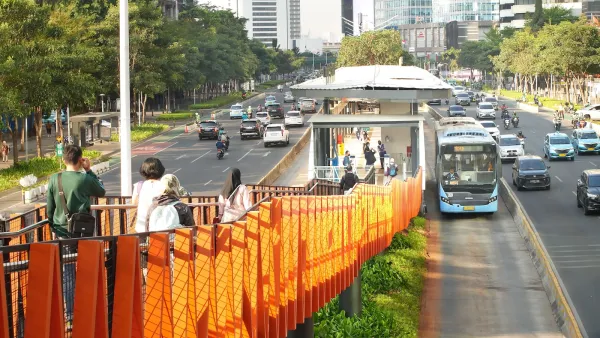
How Jakarta built the world's largest BRT system
Once known for total gridlock, the Indonesian capital has transformed itself into a public transit leader.
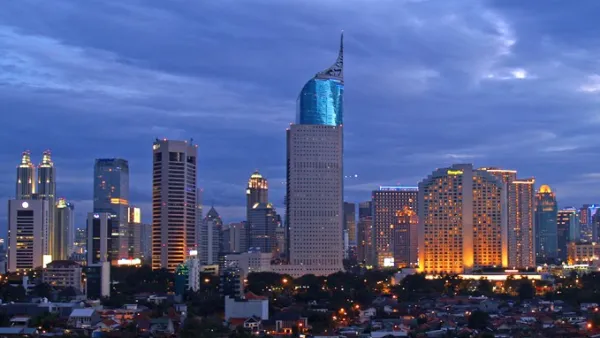
Jakarta's Suburb in the Sky
A rooftop housing development in the Indonesian capital takes the suburb to new heights.

Planetizen Federal Action Tracker
A weekly monitor of how Trump’s orders and actions are impacting planners and planning in America.

The state-sanctioned urbicide of Austin
People don’t kill cities. Freeways do.

US to reduce Colorado River water deliveries to Mexico
A new Colorado Treaty amendment reduces Mexico’s Colorado River water allocation by 250,000 acre feet.

5 New England states march closer to 800 megawatt wind energy project
Securing federal approval for the project may be complicated under the Trump administration, which has historically been hostile towards domestic wind power.

Baltimore to break ground on $50 million Transit Priority Project
The project will bring faster bus trips, safer streets and better bike connections to Baltimore.

Airbnb launches $250 million 'last-dollar financing' housing accelerator, makes first investment in Austin
The company will put $6.4 million towards affordable housing development in Texas’ capital.

FREE Course: Walkable City 1: Why Walkability?
After describing his path towards focusing on walkability as the essence of good planning, Jeff Speck marches through his five principal reasons for making more walkable places.
Reinventing Malls: Planning Alchemy—Turning Gray Fields Into Gold
The course focuses on the opportunities and imperatives that shape reinvention of mall sites.

Eagle County Government
Harvard University Graduate School of Design
Nashville Planning Department
The Architects Foundation
University of Cincinnati Online
The Pocatello Development Authority
The Urban Renewal Agency of the City of Pocatello
Journal of the American Planning Association