The Egyptian government is undertaking a broad plan to reimagine Cairo. The plan would redistribute the city's people and shuffle its industries to the outskirts of town. Some there see the plan as too much of a change.


The city is the main population center of the country, and its greater area accounts for 43% of the nation's urban population. But some worry the new plan goes too far.
"Cairo 2050, spearheaded by the ministry of housing, intends to redistribute the city's population, create 50,000 feddans of green area, move industry outside city limits and add 15 metro lines and two new railway stations in order to improve the quality of life and allow the capital to enter the global cityscape of the world's best.
According to the ministry, each Cairo resident has only 30 square centimeters of green space, far below the international standard minimum of 12 meters square. Needless to say, the city wealthiest residents are looking at the project with optimism.
"If we leave the situation as it is, in the year 2022 we will probably be living in a city of 28 million people. We have to do something, this is not a choice, this is not something we can wait on. We must move now," Housing Minister Ahmed el-Maghraby told a conference at the American Chamber of Commerce in 2007, even before the project was fully initiated."
Read the full story: Egypt tries to go greener and cleaner

Egypt's New Capital City Development Gets Chinese Backing
Plans for the development of a new, unnamed capital city just east of Cairo has received the financial backing of Chinese investors.
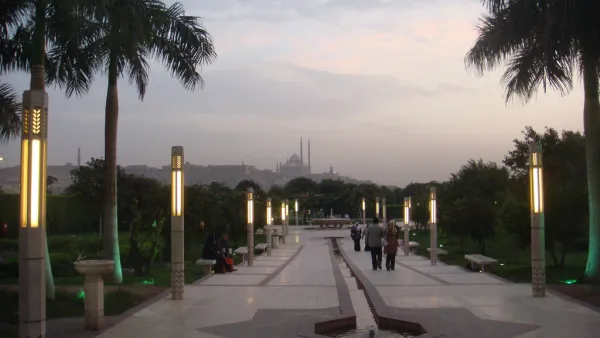
Open Spaces Are Contested Spaces in the Middle East
Parks and other public open spaces continue to be squeezed out by private development and attempts to limit political dissent throughout cities in Arab countries.
Should Egypt Build a New Capital to Replace Cairo?
Reviewing the plausibility of replacing the thousand-year-old capital of Cairo with a new, master planner, $45 billion capital city.

Planetizen Federal Action Tracker
A weekly monitor of how Trump’s orders and actions are impacting planners and planning in America.

California plans to bury El Niño’s downpour
If the state plays its cards right, it may be able to store a billion acre-feet of El Niño’s water in aquifers.

Desperate measures: Advocates weigh draining Lake Powell to fill Colorado River
Draining the reservoir could reduce evaporation losses by a couple hundred thousand acre-feet.

Chicago voters approve permanent festival grounds, penalty for vacant property owners
Currently, major summer and fall festivals take over public parks for weeks at a time, drawing criticism from nearby residents

NYC votes to cut outdoor dining red tape, speed up permitting
New York City also voted to allow the Department of Transportation to begin work on urgent projects before notifying elected officials.

California appears to reject Prop. 45
The proposition would have expanded the projects that qualify for a streamlined environmental review, effectively paring down the California Environmental Quality Act.

FREE Course: Walkable City 1: Why Walkability?
After describing his path towards focusing on walkability as the essence of good planning, Jeff Speck marches through his five principal reasons for making more walkable places.
Reinventing Malls: Planning Alchemy—Turning Gray Fields Into Gold
The course focuses on the opportunities and imperatives that shape reinvention of mall sites.

City of Rosemead
Rutgers University, Edward J. Bloustein School of Planning and Public Policy
One Hundred Miles
Hunter College, City University of New York (CUNY)
The Architects Foundation
University of Cincinnati Online
City of Cambridge
Montrose County
The Pocatello Development Authority