A new study suggests that Philadelphia's 40,000 vacant buildings reduce home values by as much as $8,000 and cost the city $20 million per year in maintenance.


The chronic problem is complicated by ownership issues, says Catherine Lucey. Various city agencies own only 25% of the properties. Some of the remaining 75% go to public auction, but many are left to decay.
Mayor Michael Nutter's administration has employed anti-blight programs to combat the problem with minimal success but is also considering models from other cities, Lucey writes:
"One example that has been heralded is in Genesee County, Mich., home to Flint, where the government set up a land bank that takes control of abandoned and tax-foreclosed properties and decides the best use - be it to sell the property to a developer, to give it to a community group or to maintain the land itself."
Read the full story: Abandoned properties have reduced city home values by an average of $8,000, study finds


Philadelphia Goes High-Tech to Monitor Vacant Properties
The city of Philadelphia has deployed high-tech sensors and a new statistical model in its ongoing fight against the blight and health problems that follow vacant and abandoned properties.
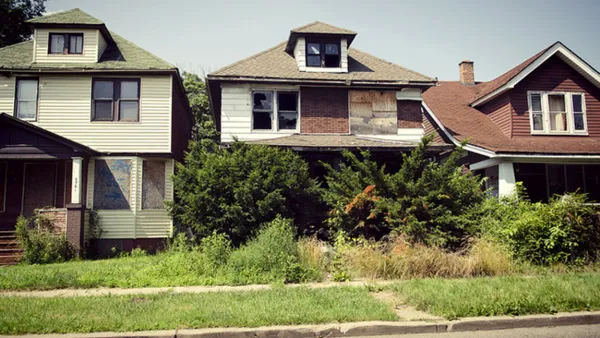
Federal Agencies Investigating the Rising Costs of Detroit's Blight Program
Detroit's aggressive blight reduction strategy, to demolish vacant homes by the thousands, is coming under scrutiny for rising costs. The FBI and the U.S. Inspector General are investigating.
Report Collects and Shares Lessons from New York's Land Banks
Practical lessons and best practices will be helpful in empowering land banks to curb the spread of blight, foreclosures, and abandoned properties.

Planetizen Federal Action Tracker
A weekly monitor of how Trump’s orders and actions are impacting planners and planning in America.

Amtrak, CN end decades-long dispute with eight-year agreement
The new operating agreement establishes an updated framework for the companies to work together, including processes to resolve disputes.

Judges permit Denver to divert 77,000 acre feet from the Colorado River for reservoir expansion
Overuse and climate change have caused the Colorado River’s water levels to plummet.

NYC DOT wants faster, more permanent street upgrades
The city is examining ways to build more concrete infrastructure without getting entangled in 'decades-long' projects.

'Something we’ve never seen before:' rising utility rates could strain city finances nationwide
Data centers, climate change and other factors have caused utility rates in the United States to increase by 38% since 2020.

Trump to overrule local leaders, lease millions of acres of America’s Pacific Island territories’ seafloors to mining companies
International law says that the Indigenous people of America’s territories have a right to prior and informed consent regarding projects that impact their countries.

FREE Course: Walkable City 1: Why Walkability?
After describing his path towards focusing on walkability as the essence of good planning, Jeff Speck marches through his five principal reasons for making more walkable places.
Reinventing Malls: Planning Alchemy—Turning Gray Fields Into Gold
The course focuses on the opportunities and imperatives that shape reinvention of mall sites.

Harvard University Graduate School of Design
KFH Group Inc.
Greater Baltimore Committee
The Architects Foundation
University of Cincinnati Online
The Pocatello Development Authority
The Urban Renewal Agency of the City of Pocatello