Yonah Freemark reports that there are more politically palatable ways to ease traffic congestion than congestion pricing.


In 2003, London implemented a congestion charge on drivers entering its central business district. The scheme was a success, generating revenues for mass transit and decreasing car movements in the mandated zone 39% while increasing ridership across railways, underground and buses.
However, The 2008 effort to institute a similar plan in New York fell to its feet in the face of organized political opposition. Freemark explains an alternative strategy, similar to the one adopted in Paris, whereby the city simply makes driving more difficult through the addition and expansion of bicycle and bus lanes, and increased parking costs. Even with no clear financial reason to stop driving, "the city saw a 17% decrease in driving between 2002 and 2007."
Freemark notes, "Paris' accomplishment, though not as large in percentage change as London's, was arguably more significant since it affected the entire city of 41 square miles, versus the original eight square miles of the London congestion zone (later roughly doubled)."
Freemark suggests that this could be an alternative for progressive US cities where congestion pricing is still politically unthinkable.
Read the full story: An Alternative To Congestion Pricing: Roadway Traffic Restraint
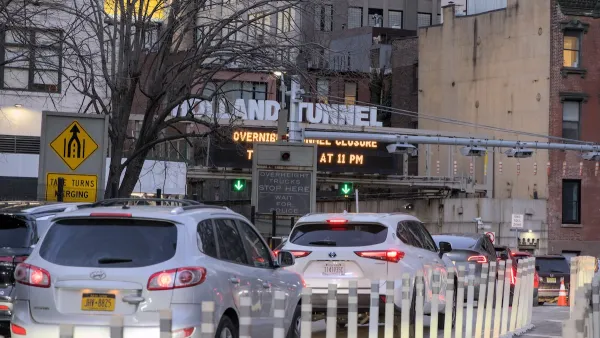
NYC Congestion Pricing Continues to Show Positive Results
While the Trump administration attempts to revoke the program’s federal approval, congestion pricing continues to reduce traffic, speed up bus travel times, and improve air quality in Manhattan.
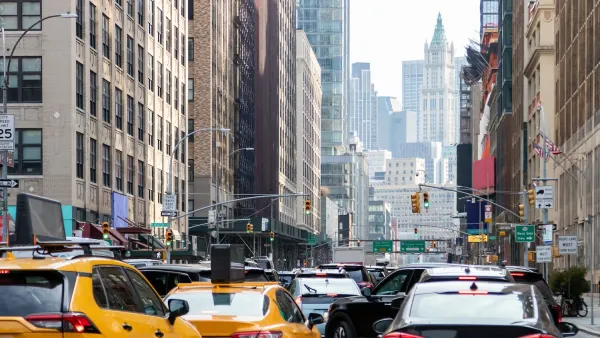
Agreement Keeps NYC Congestion Pricing Alive Through Summer
The tolling program will continue while a court considers the city’s lawsuit against the Trump administration.
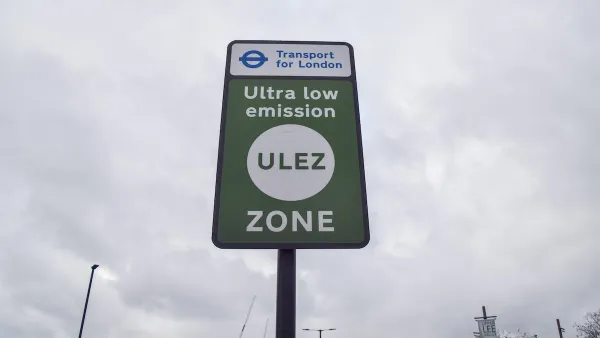
London Congestion Pricing Zone Has No Impact on Local Spending
The city’s cordon pricing scheme did not affect how much people spent at local businesses, new research finds.

Planetizen Federal Action Tracker
A weekly monitor of how Trump’s orders and actions are impacting planners and planning in America.

California plans to bury El Niño’s downpour
If the state plays its cards right, it may be able to store a billion acre-feet of El Niño’s water in aquifers.

Desperate measures: Advocates weigh draining Lake Powell to fill Colorado River
Draining the reservoir could reduce evaporation losses by a couple hundred thousand acre-feet.

Mamdani’s pied-à-terre tax survives legal challenge
A panel of judges found that the plaintiffs failed to demonstrate injury as a result of New York City's implementation of the tax.

Eastern Nebraska is running out of electricity
Data centers and electrification are straining eastern Nebraska’s grid, throttling economic development.

Seattle passes record-breaking transit services expansion
Proposition 1 will double the city’s transit tax to add 95,000 more bus trips and preserve 180,000 bus trips annually.

FREE Course: Walkable City 1: Why Walkability?
After describing his path towards focusing on walkability as the essence of good planning, Jeff Speck marches through his five principal reasons for making more walkable places.
Reinventing Malls: Planning Alchemy—Turning Gray Fields Into Gold
The course focuses on the opportunities and imperatives that shape reinvention of mall sites.

City of Rosemead
Rutgers University, Edward J. Bloustein School of Planning and Public Policy
One Hundred Miles
Hunter College, City University of New York (CUNY)
The Architects Foundation
University of Cincinnati Online
City of Cambridge
Montrose County
The Pocatello Development Authority