USA Today's traveler reporter asks, "Should the U.S. invest in High-Speed Rail?" (readers check their answer and results are available). He cites the usual critics but also notes the challenges it must face in order to build a successful line.


Citing the example of Amtrak's Acela Express that has the capabiity of traveling at 150 mph but averages much lower speeds, Billy McGee questions continued investment in high speed rail in the U.S., wondering if perhaps those funds would best be spent on roads and runways.
"When it comes to high-speed rail, advanced technologies often need to work within the confines of existing infrastructure. The United States could begin building the world's fastest trains tomorrow, but until we develop new systems, in many cases those trains would still be operating on aged rails, switches, bridges and tunnels, and fighting for space with freight trains and slower passenger trains. [See HSR News: Freight Rail Sabotaging High-Speed Plans].
The challenge for America will be rebuilding railroad infrastructure that in some areas has not been fundamentally upgraded for nearly a century.
Travelers, do you think the U.S. should continue to invest in high-speed rail? Or would you prefer transportation funds go to "Roads and Runways?" Please post your comments below." [USA Today Log-in required to post comments, but not necessary to answer survey question on left side].
Thanks to John Hartz
Read the full story: Is high-speed rail on track in the U.S.?
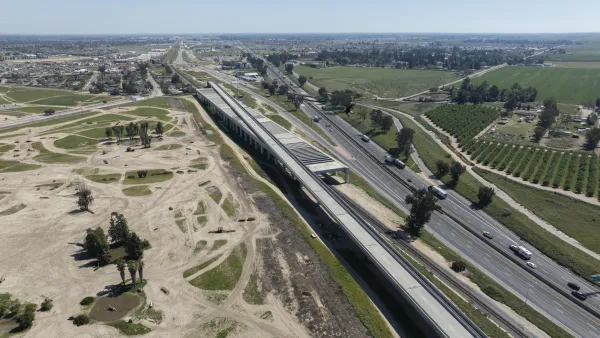
California High-Speed Rail Authority could be broke by the end of 2027
A report from the Office of Inspector General says the authority must borrow against state infusions to stay afloat.
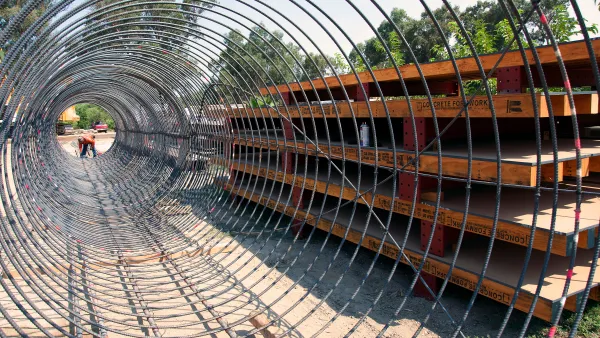
California High Speed Rail to lay first tracks
High Speed Rail Authority officials describe the milestone as "the moment this project truly begins to become a railroad."
TOD Opportunities Around America's First True High-Speed Rail Line
Brightline West hopes to break ground, in anticipation of a 2027 opening. Cities in the Inland Empire and High Desert areas of Southern California are looking to take advantage.

Planetizen Federal Action Tracker
A weekly monitor of how Trump’s orders and actions are impacting planners and planning in America.

California plans to bury El Niño’s downpour
If the state plays its cards right, it may be able to store a billion acre-feet of El Niño’s water in aquifers.

Desperate measures: Advocates weigh draining Lake Powell to fill Colorado River
Draining the reservoir could reduce evaporation losses by a couple hundred thousand acre-feet.

Mamdani’s pied-à-terre tax survives legal challenge
A panel of judges found that the plaintiffs failed to demonstrate injury as a result of New York City's implementation of the tax.

Eastern Nebraska is running out of electricity
Data centers and electrification are straining eastern Nebraska’s grid, throttling economic development.

Seattle passes record-breaking transit services expansion
Proposition 1 will double the city’s transit tax to add 95,000 more bus trips and preserve 180,000 bus trips annually.

FREE Course: Walkable City 1: Why Walkability?
After describing his path towards focusing on walkability as the essence of good planning, Jeff Speck marches through his five principal reasons for making more walkable places.
Reinventing Malls: Planning Alchemy—Turning Gray Fields Into Gold
The course focuses on the opportunities and imperatives that shape reinvention of mall sites.

City of Rosemead
Rutgers University, Edward J. Bloustein School of Planning and Public Policy
One Hundred Miles
University of Michigan School for Environment and Sustainability (SEAS)
Hunter College, City University of New York (CUNY)
The Architects Foundation
City of Cambridge
Montrose County
The Pocatello Development Authority