Cyclists who disobey traffic laws are the No. 1 police complaint among residents of Manhattan's Upper East Side. Could the built environment be the real culprit?


New Urban Network says that while the brouhaha over bicylists is blown way out of proportion (check out their comparison of bicyclist-caused accidents vs. automobile accidents), street design might actually be to blame for some of the clashing behavior:
"...Jim Charlier of Charlier Associates planning consultants in Boulder, Colorado, observed that in dense urban centers, 'all kinds of improvised behavior are going on.' Pedestrians jaywalk. Cyclists go up on sidewalks. If it's 'low-speed behavior,' Charlier said, the danger is less than it might otherwise be. In some instances, the design of the built environment can alleviate the problem. Boulder and some other cities have installed 'contra-flow' bike lanes on some one-way streets so that cyclists can ride legally and safely in the opposite direction of motor vehicles."
Thanks to Renee Brutvan
Read the full story: Conflict between cyclists and pedestrians spurs calls for action in New York
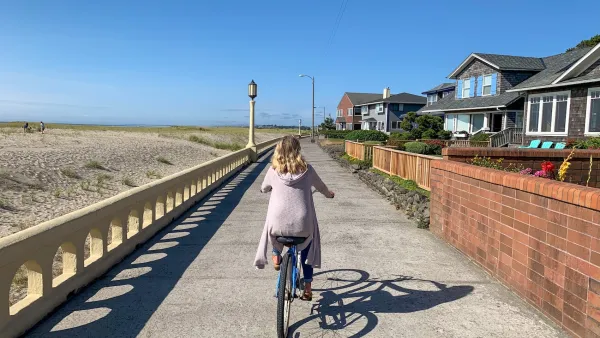
Oregon updates coastal bike map for the first time in a decade
The printed guide helps cyclists navigate the coastal region where cellular service can be unpredictable.
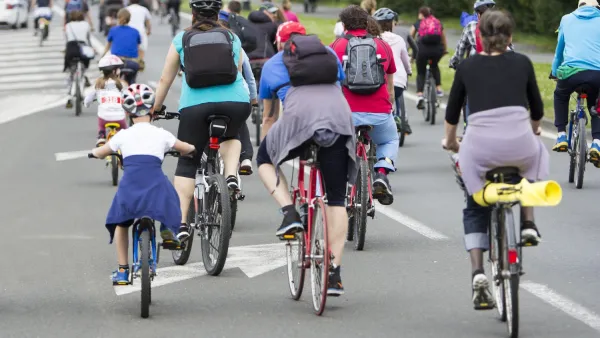
Unleashing the Power of Cycling With Smart Messaging
Lloyd Alter describes how creative design and copywriting can flip the script and promote active transport.
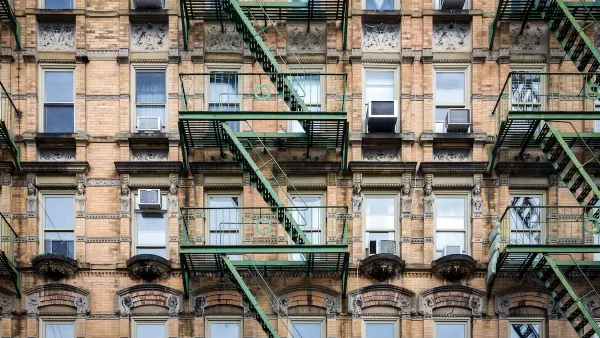
Beating Extreme Heat Through Community Efforts
U.S. cities don't provide residents with enough protection against heat, the deadliest weather-related killer in the world. In New York City, one organization came together to distribute ACs to neighbors in need.

Planetizen Federal Action Tracker
A weekly monitor of how Trump’s orders and actions are impacting planners and planning in America.

California plans to bury El Niño’s downpour
If the state plays its cards right, it may be able to store a billion acre-feet of El Niño’s water in aquifers.

Desperate measures: Advocates weigh draining Lake Powell to fill Colorado River
Draining the reservoir could reduce evaporation losses by a couple hundred thousand acre-feet.

US buildings threatened, destroyed by fires set to triple by 2060
Researchers found a high fire risk for socioeconomically vulnerable neighborhoods in the American West.

LA residents may be allowed to paint their own crosswalks
Councilwoman Katy Yaroslavsky put out a motion instructing the Los Angeles Department of Public Transportation to study the feasibility of allowing volunteers to paint crosswalks.

Dallas moves to overhaul its zoning code
The city's zoning reform will allow more multi-family and mixed-use developments.

FREE Course: Walkable City 1: Why Walkability?
After describing his path towards focusing on walkability as the essence of good planning, Jeff Speck marches through his five principal reasons for making more walkable places.
Reinventing Malls: Planning Alchemy—Turning Gray Fields Into Gold
The course focuses on the opportunities and imperatives that shape reinvention of mall sites.

City of Rosemead
Rutgers University, Edward J. Bloustein School of Planning and Public Policy
One Hundred Miles
Hunter College, City University of New York (CUNY)
The Architects Foundation
University of Cincinnati Online
City of Cambridge
Montrose County
The Pocatello Development Authority