Dan Bertolet argues that adding expanding car capacity in cities just inspires more people to drive and ruins the qualities that make the city attractive in the first place.


Bertolet was inspired to write in response to naysayers speaking out against expanding bicycle and pedestrian infrastructure in Seattle:
"The crucial point is that car infrastructure not only encourages driving, it also sabotages mobility by any other means. It's a vicious cycle: roads beget sprawl begets car dependence begets roads, and so on. And the result is an ever-expanding built environment in which walking, biking, and transit are not viable options.
The only way to break the vicious cycle is to invest our limited transportation dollars in infrastructure that will help make walking, biking, and transit more attractive than driving."
Read the full story: Car Capacity Is Not Sacred
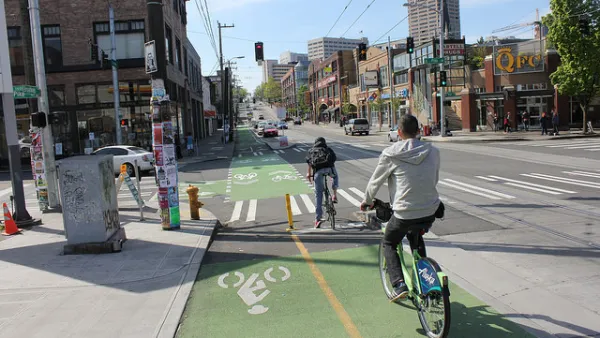
The Uncertain Future of Seattle's Bicycle Master Plan
By prioritizing a multi-modal approach and preserving existing vehicle space, the Seattle Department of Transportation risks abandoning the goals of its bicycle master plan.

Op-Ed: 'Public Mood' Has Turned Against Cars in Cities
A survey of recent planning decisions demonstrates that cities are no longer necessarily looking to more and bigger highways to solve their traffic problems.
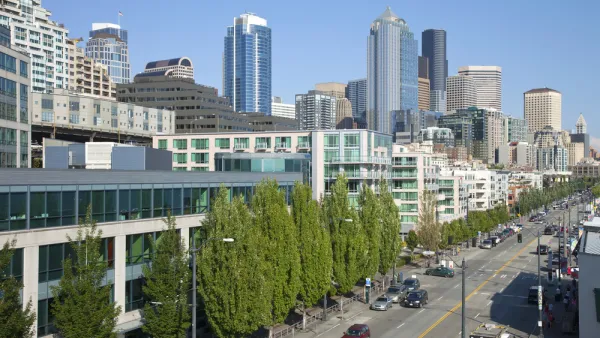
Against Seattle's Waterfront Highway
Seattle is set to build a nine-lane tunnel on its waterfront, the Urbanist's Ryan Packer is disappointed with its design and the project's stated goals.

Desperate measures: Advocates weigh draining Lake Powell to fill Colorado River
Draining the reservoir could reduce evaporation losses by a couple hundred thousand acre-feet.

Eastern Nebraska is running out of electricity
Data centers and electrification are straining eastern Nebraska’s grid, throttling economic development.

Move over, LA: St. Louis gears up for Olympics, invests millions in downtown redevelopment
The Missouri city will host the 2028 Olympic soccer group stage and knockout matches.

‘No clear next steps’ for Chicago's permanent festival grounds
Eleventh Ward Ald. Nicole Lee has suggested Soldier Field as a possible location for the permanent event space.

California, Hawaii, Rhode Island approve housing propositions
Hawaii and Rhode Island each approved their sole proposition, while California approved two of its three.

Officials claim feds 'rushed' Amtrak environmental review
Amtrak plans to move their Chicago maintenance facility from an industrial area to a residential one.

FREE Course: Walkable City 1: Why Walkability?
After describing his path towards focusing on walkability as the essence of good planning, Jeff Speck marches through his five principal reasons for making more walkable places.
Reinventing Malls: Planning Alchemy—Turning Gray Fields Into Gold
The course focuses on the opportunities and imperatives that shape reinvention of mall sites.

City of Rosemead
Rutgers University, Edward J. Bloustein School of Planning and Public Policy
One Hundred Miles
University of Michigan School for Environment and Sustainability (SEAS)
Hunter College, City University of New York (CUNY)
The Architects Foundation
City of Cambridge
Montrose County
The Pocatello Development Authority