Next American City reviews a new book by Matt Dellinger about Interstate 69, the as-yet-unbuilt highway that could create a direct link between the Mexican and Canadian borders.


Seen as both an opportunity for economic development and the further ruination of the country with large-scale car-focused infrastructure, Interstate 69 is still very much an unanswered question.
"Dellinger places the highway's development alongside the personal narratives of the actors working faithfully to build it-or, on the other hand, to stop it before it is completed. The highway, it becomes quickly apparent, is far more than just a way to get from one place to the next: It embodies a conflict over growth, progress, even destiny.
If completed, I-69 would connect Detroit with Indianapolis, Memphis, Shreveport, and Houston in a straight-shot diagonal across the nation. The section between Indiana's capital and the Canadian border was completed in the 1950s, but most of the rest of the route isn't even funded; only two small sections, one in Indiana and the other in Mississippi, have been completed. It would be the last traditional Interstate highway to be built. But its fate has yet to be sealed: Its arguably duplicative route between areas that, with the exception of Texas, aren't growing in population, has attracted serious criticism in some parts."
Read the full story: Driven Over by I-69

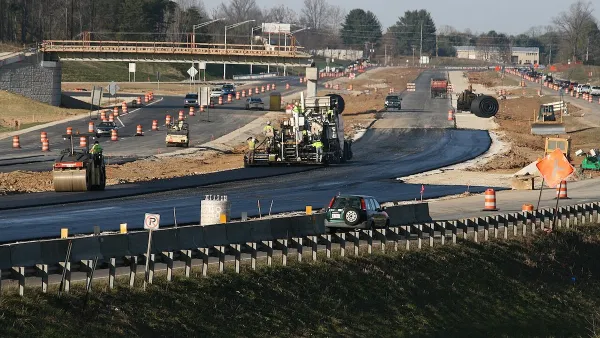
Indiana Segment of Canada-to-Mexico Freeway to Open This Year
The state’s transportation department is reaching completion on its segment of a major north-south corridor that will eventually reach from Michigan to Texas.
Trump to allow infrastructure along highways, railways in bid to bypass reviews
By building lines close to existing infrastructure, Trump aims to lower costs and bypass environmental oversight and opposition from local communities.
Milwaukee mayor abandons highway removal plan
Mayor Johnson spoke in opposition to a proposed plan to turn part of I-794 into an at-grade boulevard, expressing concerns about traffic.

Planetizen Federal Action Tracker
A weekly monitor of how Trump’s orders and actions are impacting planners and planning in America.

Amtrak, CN end decades-long dispute with eight-year agreement
The new operating agreement establishes an updated framework for the companies to work together, including processes to resolve disputes.

Judges permit Denver to divert 77,000 acre feet from the Colorado River for reservoir expansion
Overuse and climate change have caused the Colorado River’s water levels to plummet.

Boston has spent millions making the Green Line more accessible — and there’s no end in sight
While the city has invested millions into expanding and adding platforms to the Green Line to make it more accessible, new train cars set to arrive next year will be too tall for disabled passengers to board without raising the current platforms.

Idaho may see an 18% drop in federal surface transit funding — the largest estimated cut in the US
Transit systems in rural communities are much more reliant on federal funding to provide their services.

How ‘post-disaster gentrification’ alters neighborhoods after natural calamities
After hurricanes, fires or other calamities, the original residents of a community are often replaced by younger, wealthier residents.

FREE Course: Walkable City 1: Why Walkability?
After describing his path towards focusing on walkability as the essence of good planning, Jeff Speck marches through his five principal reasons for making more walkable places.
Reinventing Malls: Planning Alchemy—Turning Gray Fields Into Gold
The course focuses on the opportunities and imperatives that shape reinvention of mall sites.

City of Wisconsin Rapids
Harvard University Graduate School of Design
KFH Group Inc.
The Architects Foundation
University of Cincinnati Online
The Pocatello Development Authority
The Urban Renewal Agency of the City of Pocatello