After decades of decline in their populations, young creative types are fueling the rebirth of Rust Belt cities.


Roberta Brandes Gratz writes about the trend, which is luring young people to now cheap places like Detroit and Syracuse.
"For decades, people like Mr. Destito - young, skilled, motivated - were exactly the sort who left Rust Belt cities like Syracuse. But recently, in numbers not yet statistically measurable but clearly evident at the ground level, they've been coming back to the city, first as a trickle, and now by the hundreds. In some ways it's a part of the natural ebb and flow of urban demographics. But it is also the result of a new attitude among the city's leadership, one that admits the failure of the re-industrialization efforts of the last decades and instead invents ways to attract new types of residents and keep current ones from leaving. Call it urban renewal 2.0, gentrification on a citywide scale."
Read the full story: Rebirth of a City

Dan Gilbert Announces $500 Million Investment in Detroit Neighborhoods
Dan Gilbert, the billionaire credited with the revitalization of development interest in and around Downtown Detroit, made a bombshell announcement in his first in-depth interview since suffering a stroke in 2019.
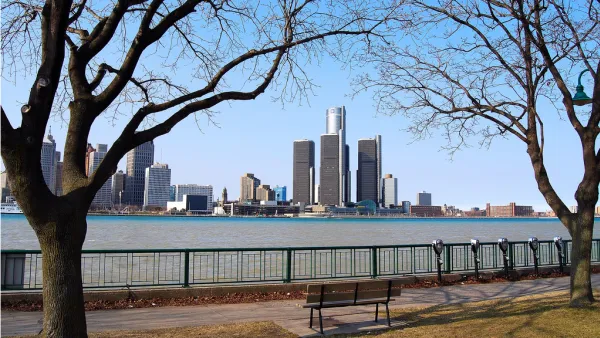
Lessons from Masterminds of Detroit's Rebirth
The enthusiasm of Detroit's new civic leadership, who engineered its bankruptcy and set up its recovery, is infectious. How the city will ultimately fare, and how other troubled cities learn from Detroit's mistakes, remains to be seen.
What's the Opposite of Gentrification?
Richey Piiparinen says that in one obvious way, gentrification isn't a problem in the Rust Belt (that being housing prices, which are comfortably low pretty much everywhere). A true intermingling of racial and ethnic groups is happening, he argues.

Planetizen Federal Action Tracker
A weekly monitor of how Trump’s orders and actions are impacting planners and planning in America.

California plans to bury El Niño’s downpour
If the state plays its cards right, it may be able to store a billion acre-feet of El Niño’s water in aquifers.

Desperate measures: Advocates weigh draining Lake Powell to fill Colorado River
Draining the reservoir could reduce evaporation losses by a couple hundred thousand acre-feet.

Chicago voters approve permanent festival grounds, penalty for vacant property owners
Currently, major summer and fall festivals take over public parks for weeks at a time, drawing criticism from nearby residents

NYC votes to cut outdoor dining red tape, speed up permitting
New York City also voted to allow the Department of Transportation to begin work on urgent projects before notifying elected officials.

California appears to reject Prop. 45
The proposition would have expanded the projects that qualify for a streamlined environmental review, effectively paring down the California Environmental Quality Act.

FREE Course: Walkable City 1: Why Walkability?
After describing his path towards focusing on walkability as the essence of good planning, Jeff Speck marches through his five principal reasons for making more walkable places.
Reinventing Malls: Planning Alchemy—Turning Gray Fields Into Gold
The course focuses on the opportunities and imperatives that shape reinvention of mall sites.

City of Rosemead
Rutgers University, Edward J. Bloustein School of Planning and Public Policy
One Hundred Miles
Hunter College, City University of New York (CUNY)
The Architects Foundation
University of Cincinnati Online
City of Cambridge
Montrose County
The Pocatello Development Authority