Richey Piiparinen says that in one obvious way, gentrification isn't a problem in the Rust Belt (that being housing prices, which are comfortably low pretty much everywhere). A true intermingling of racial and ethnic groups is happening, he argues.


Pilparinen says that the gentrification model is "way out of whack" in the Rust Belt, where African-Americans are leaving the inner city for the depressed housing market of the suburbs:
"In fact, in terms of creating mixed neighborhoods, this is usually the model-turning the talking points of gentrification on its head," writes Pilparinen.
Mixed neighborhoods are increasing and becoming the norm, he writes:
"The link between generational tolerance and neighborhood change is that altered perceptions lead to changed behaviors and thus new experiences. These experiences: they go from person to person, which then are rapidly leading to the increased prevalence of everyday between-race interactions if not multi-racial nuclear family units. Slowly, then, the creation of integrated neighborhoods ensue that evolve more organically than the colonialist model of gentrification states."
FULL STORY: Rust Belt Conditions Flip Gentrification Patterns

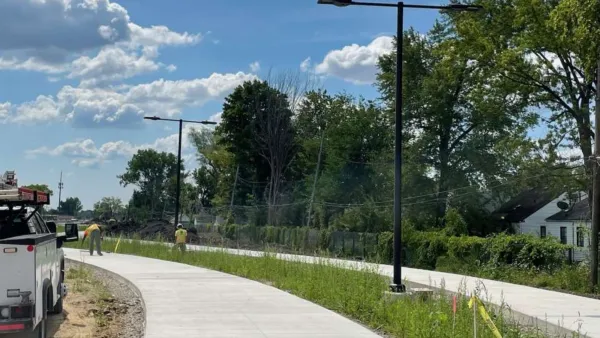
Detroit greenway brings revival — and fears of displacement
The planned Joe Louis Greenway is already bringing change to the neighborhoods near it.
No Connection Between Gardens and Gentrification in Detroit, Study Says
Research from late 2021 documented the footprint of urban gardens in Detroit, finding evidence of inequities but not gentrification.
Dan Gilbert Announces $500 Million Investment in Detroit Neighborhoods
Dan Gilbert, the billionaire credited with the revitalization of development interest in and around Downtown Detroit, made a bombshell announcement in his first in-depth interview since suffering a stroke in 2019.

Planetizen Federal Action Tracker
A weekly monitor of how Trump’s orders and actions are impacting planners and planning in America.

The state-sanctioned urbicide of Austin
People don’t kill cities. Freeways do.

US to reduce Colorado River water deliveries to Mexico
A new Colorado Treaty amendment reduces Mexico’s Colorado River water allocation by 250,000 acre feet.

5 New England states march closer to 800 megawatt wind energy project
Securing federal approval for the project may be complicated under the Trump administration, which has historically been hostile towards domestic wind power.

Baltimore to break ground on $50 million Transit Priority Project
The project will bring faster bus trips, safer streets and better bike connections to Baltimore.

Airbnb launches $250 million 'last-dollar financing' housing accelerator, makes first investment in Austin
The company will put $6.4 million towards affordable housing development in Texas’ capital.

FREE Course: Walkable City 1: Why Walkability?
After describing his path towards focusing on walkability as the essence of good planning, Jeff Speck marches through his five principal reasons for making more walkable places.
Reinventing Malls: Planning Alchemy—Turning Gray Fields Into Gold
The course focuses on the opportunities and imperatives that shape reinvention of mall sites.

Eagle County Government
Harvard University Graduate School of Design
Nashville Planning Department
The Architects Foundation
University of Cincinnati Online
The Pocatello Development Authority
The Urban Renewal Agency of the City of Pocatello
Journal of the American Planning Association