Plans to expand the Bay Area's BART system to the Silicon Valley have brought into question the future of a San Jose flea market that some want to turn into a transit-oriented development.


The city wants to build nearly 3,000 residential units on the site, but some say their plans don't do enough to create an urban village in the area.
"The flea market's owner, the Bumb family, supports the city's broad goals for the area, but intends to build up to roughly 2,800 housing units on the property, many of them single-family homes. While city officials approved that plan, it falls short of their hopes to see an urban center emerge in what is now a sparsely developed part of town.
The city has little clout to alter the family's plan, says San Jose Mayor Chuck Reed. The Bumbs 'have property rights, and they are entitled to certain things there,' he says. But placing lower-density development on the site would be a disappointment, he adds. The flea market is 'an opportunity for a very large site to be developed in a planned way, and you don't get many of those in the Bay Area.'"
Read the full story: BART Plan Exposes City's Challenges
Transit Village Plans Popping Up All Over San Jose
A long-awaited BART extension into San Jose, California is also bringing major development interest of the transit-oriented variety.

South Bay BART Extension Gets $5.1 Billion in Federal Funding
The grant brings the project closer to reality, but delays and cost overruns are putting a completion date more than a decade away.
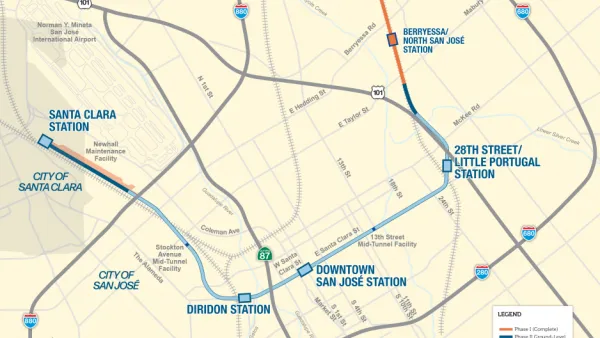
BART’s Phase II Extension Into San Jose Ready to Go
A long-awaited extension of the Bay Area’s regional rail transit system is finally coming into view, with an expected completion date of 2030.

Planetizen Federal Action Tracker
A weekly monitor of how Trump’s orders and actions are impacting planners and planning in America.

California plans to bury El Niño’s downpour
If the state plays its cards right, it may be able to store a billion acre-feet of El Niño’s water in aquifers.

Desperate measures: Advocates weigh draining Lake Powell to fill Colorado River
Draining the reservoir could reduce evaporation losses by a couple hundred thousand acre-feet.

Los Angeles just elected an urban planner as its mayor
Transportation analysts are optimistic that Raman will be more aggressive in addressing transit issues than Bass.

Mamdani’s pied-à-terre tax survives legal challenge
A panel of judges found that the plaintiffs failed to demonstrate injury as a result of New York City's implementation of the tax.

Eastern Nebraska is running out of electricity
Data centers and electrification are straining eastern Nebraska’s grid, throttling economic development.

FREE Course: Walkable City 1: Why Walkability?
After describing his path towards focusing on walkability as the essence of good planning, Jeff Speck marches through his five principal reasons for making more walkable places.
Reinventing Malls: Planning Alchemy—Turning Gray Fields Into Gold
The course focuses on the opportunities and imperatives that shape reinvention of mall sites.

City of Rosemead
Rutgers University, Edward J. Bloustein School of Planning and Public Policy
One Hundred Miles
University of Michigan School for Environment and Sustainability (SEAS)
Hunter College, City University of New York (CUNY)
The Architects Foundation
City of Cambridge
Montrose County
The Pocatello Development Authority