Transit advocates are used to battling the 'road lobby', but this article reports on a clash between small and mid-sized transit agencies (who want more flexibility) against the larger ones, as well as the main transit lobbying organization, APTA.


The article reports on a Cleveland suburb's transit crisis where the transit agency received stimulus funds for new buses at the same time lack of operating assistance caused it to eliminate most its routes. This seemingly contradictory scenario is being played out throughout the country - yet there appears reluctance on the part of the transit agencies themselves to fix the funding imbalance problem.
"The $787 billion (federal) stimulus package included $8 billion for mass transit, but in keeping with longstanding rules, most of the money has to be used for capital investment. As a result, transit agencies are laying off workers, raising fares and slashing service to close yawning budget gaps.
To address this imbalance, a bipartisan group is pushing legislation that would give transit systems more freedom to use federal funding -- $10 billion a year on top of the stimulus money -- as they see fit. But the legislation is facing unlikely resistance: Some of the biggest transit agencies, such as New York's MTA and Washington's Metro, are opposed, as is the main transit lobbying group (American Public Transit Association), setting up an unusual clash in the mass transit world."
Thanks to Christian Peeples
Read the full story: Funding rules fuel clash within mass transit world

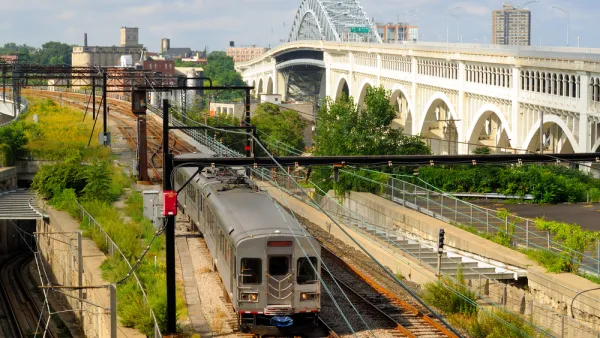
A Model for Cleveland's Transit Woes: Houston
Alex Baca says following Houston's lead could lead the Greater Cleveland Regional Transit Authority out of a budget and ridership spiral.
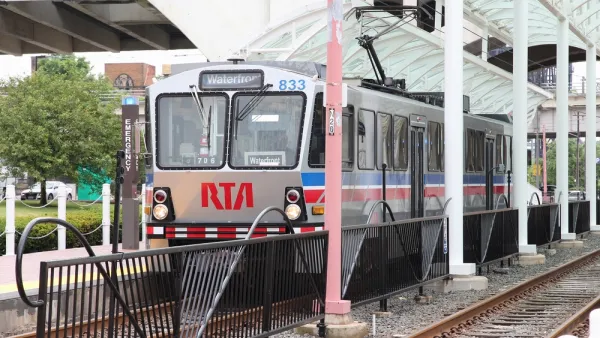
Funding Shortfalls Result in Service Cuts for Cleveland's Regional Transit Authority
A $20 million hole in the Greater Cleveland Regional Transit Authority's (RTA) budget means 15 bus lines around the city will run less frequently. More cuts are soon to come.
As the State Abandons Public Transit, Is a Regional Solution Possible for Northeast Ohio?
Many states cover around 20 percent of the costs of public transit. In Ohio, that figure has dropped to 1 percent.

Planetizen Federal Action Tracker
A weekly monitor of how Trump’s orders and actions are impacting planners and planning in America.

California plans to bury El Niño’s downpour
If the state plays its cards right, it may be able to store a billion acre-feet of El Niño’s water in aquifers.

Desperate measures: Advocates weigh draining Lake Powell to fill Colorado River
Draining the reservoir could reduce evaporation losses by a couple hundred thousand acre-feet.

Metra may invest $9.1 billion in regional rail
The agency released a draft of a study examining potential ways to offer more frequent train service.

California city breaks ground on transit connector
The project includes three mobility hubs and a pedestrian bridge.

After public outcry, Massachusetts city releases housing development tracker
Cambridge’s tracker currently shows 250 housing projects in various stages of development.

FREE Course: Walkable City 1: Why Walkability?
After describing his path towards focusing on walkability as the essence of good planning, Jeff Speck marches through his five principal reasons for making more walkable places.
Reinventing Malls: Planning Alchemy—Turning Gray Fields Into Gold
The course focuses on the opportunities and imperatives that shape reinvention of mall sites.

City of Rosemead
Rutgers University, Edward J. Bloustein School of Planning and Public Policy
One Hundred Miles
Hunter College, City University of New York (CUNY)
The Architects Foundation
University of Cincinnati Online
City of Cambridge
Montrose County
The Pocatello Development Authority