Will a new automated, self-cleaning public restroom system provide relief to Torontonians?


Cities throughout history have made provision for bodily needs, from Rome's public latrines to London's underground "public convenience." However, vandalism, poor maintenance and fear of crime have led most cities to close them. Now Toronto is hoping that contract with a private company to build and maintain automated public toilets will help change public perceptions...and habits. According to the Globe and Mail:
"Most cities don't have nearly enough [public toilets] leaving tourists and residents alike to duck into pubs or even disappear behind a bush. The public toilets that do exist are often filthy, graffiti-stained and prone to vandalism. Nothing tells the [Toronto Transit's] tale of decline and neglect as eloquently as the state of some of its station washrooms. The concrete-floored lavs in our public parks are often even worse.
The automated public toilet, or APT, is an attempt to close the toilet gap."
Read the full story: Toronto unveils its first automated public toilet
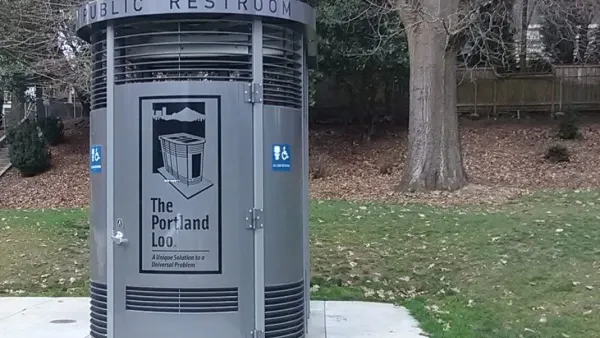
New York City Parks Getting Modular Public Bathrooms
The ‘Portland Loo,’ named after its birth city, is designed to withstand year-round weather and resist vandalism.
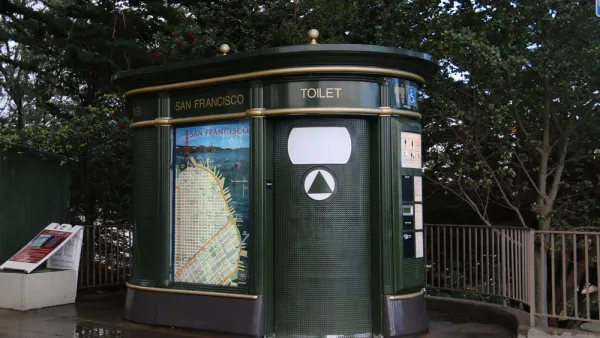
Uproar Over San Francisco’s $1.7 Million Toilet
Critics question why a single-toilet public bathroom could cost the city close to $2 million and take two years to build.
Opinion: Keep Public Toilets at L.A. Homeless Encampments
The city is planning to remove the hundreds of public toilets and hand-washing stations installed during the pandemic. But the need for them isn't going away.

Planetizen Federal Action Tracker
A weekly monitor of how Trump’s orders and actions are impacting planners and planning in America.

California plans to bury El Niño’s downpour
If the state plays its cards right, it may be able to store a billion acre-feet of El Niño’s water in aquifers.

Desperate measures: Advocates weigh draining Lake Powell to fill Colorado River
Draining the reservoir could reduce evaporation losses by a couple hundred thousand acre-feet.

In Texas, data centers are swallowing promised parkland
Residents who moved to Taylor, Texas for a rural community now have to contend with three data centers in their backyard.

How a Chicago-sized wind farm beat the odds and powered on
The project spanned five presidential administrations and a standoff with a U.S. military base.

MTA gives itself 30 days to transform pit into basketball court
The site has been under construction since 2022; the city originally estimated it would finish the court in 2024.

FREE Course: Walkable City 1: Why Walkability?
After describing his path towards focusing on walkability as the essence of good planning, Jeff Speck marches through his five principal reasons for making more walkable places.
Reinventing Malls: Planning Alchemy—Turning Gray Fields Into Gold
The course focuses on the opportunities and imperatives that shape reinvention of mall sites.

City of Rosemead
Rutgers University, Edward J. Bloustein School of Planning and Public Policy
One Hundred Miles
Hunter College, City University of New York (CUNY)
The Architects Foundation
University of Cincinnati Online
City of Cambridge
Montrose County
The Pocatello Development Authority