The move towards growing produce locally in urban areas is not just a U.S. phenomenon, says CNN. China, Japan and Cuba have had agriculture in cities for decades.


Havana has over 200 farms, spurred during the era after the Soviet Union collapsed and the Cuban oil supply rocketed. The Cuban model of urban farming is an inspiration for groups around the world.
And in Africa, an Italian charity is handing out a "farm in a sack" to needy families.
"[The] "farm-in-a-sack" project provides poor families with more than 40 seedlings, which can be grown into food in just a few weeks. Each "base" or mini-farm can provide vegetables such as spinach for 150 families, says COOPI.
Claudio Torres, from COOPI, said: "There are two effects. There is the main effect that they really have more food and that's like nutrition and micronutrients. But also, as you can see, this brings together the community.""
Read the full story: Urban farms herald green city 'revolution'
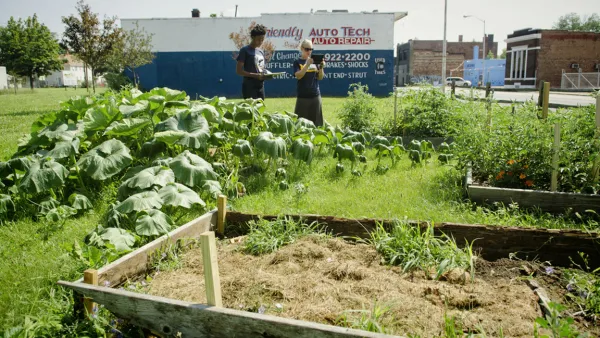
Self Sufficiency Through Urban Farming
Lessons from a successful urban farming effort can be applied to achieve resource independence aside from just food.
Cuba Serves As Model For Urban Farming
With urban farms sprinkled throughout the island, Cuba is proving to be one of the world's most successful models of how to integrate agriculture into urban areas.
Urban Farms Create Flow of Food and Cash in Cuba
Urban farms in Cuba have proven successful at feeding the country and providing hundreds of thousands of jobs.

Planetizen Federal Action Tracker
A weekly monitor of how Trump’s orders and actions are impacting planners and planning in America.

California plans to bury El Niño’s downpour
If the state plays its cards right, it may be able to store a billion acre-feet of El Niño’s water in aquifers.

Desperate measures: Advocates weigh draining Lake Powell to fill Colorado River
Draining the reservoir could reduce evaporation losses by a couple hundred thousand acre-feet.

Chicago voters approve permanent festival grounds, penalty for vacant property owners
Currently, major summer and fall festivals take over public parks for weeks at a time, drawing criticism from nearby residents

NYC votes to cut outdoor dining red tape, speed up permitting
New York City also voted to allow the Department of Transportation to begin work on urgent projects before notifying elected officials.

California appears to reject Prop. 45
The proposition would have expanded the projects that qualify for a streamlined environmental review, effectively paring down the California Environmental Quality Act.

FREE Course: Walkable City 1: Why Walkability?
After describing his path towards focusing on walkability as the essence of good planning, Jeff Speck marches through his five principal reasons for making more walkable places.
Reinventing Malls: Planning Alchemy—Turning Gray Fields Into Gold
The course focuses on the opportunities and imperatives that shape reinvention of mall sites.

City of Rosemead
Rutgers University, Edward J. Bloustein School of Planning and Public Policy
One Hundred Miles
Hunter College, City University of New York (CUNY)
The Architects Foundation
University of Cincinnati Online
City of Cambridge
Montrose County
The Pocatello Development Authority