With urban farms sprinkled throughout the island, Cuba is proving to be one of the world's most successful models of how to integrate agriculture into urban areas.


"Now, in the wake of three hurricanes that wiped out 30 percent of Cuba's farm crops, the communist country is again turning to its urban gardens to keep its people properly fed."
"Around 15 percent of the world's food is grown in urban areas, according to the U.S. Department of Agriculture, a figure experts expect to increase as food prices rise, urban populations grow and environmental concerns mount."
"Since they sell directly to their communities, city farms don't depend on transportation and are relatively immune to the volatility of fuel prices, advantages that are only now gaining traction as "eat local" movements in rich countries."
"In Cuba, urban gardens have bloomed in vacant lots, alongside parking lots, in the suburbs and even on city rooftops."
"They have proven extremely popular, occupying 35,000 hectares (86,000 acres) of land across the Caribbean island. Even before the hurricanes, they produced half of the leaf vegetables eaten in Cuba, which imports about 60 percent of its food."
Read the full story: In "eat local" movement, Cuba is years ahead

Urban Farming Addressing Hunger (and More) in Pittsburgh
Urban farming provides opportunities to increase food security in addition to other benefits.

Minnesota Grants May Bolster Urban Farming's Legitimacy
For the first time, the state of Minnesota is offering money specifically for urban agriculture, in a win for urban farmers who want to challenge the notion that agriculture is necessarily a rural enterprise.
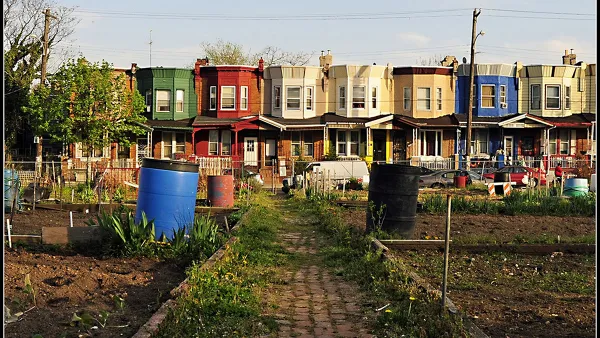
The Future of Farming is Millennials
An aging population of farmers may give way to a generation of young entrepreneurs who see the value and values of growing food.

Planetizen Federal Action Tracker
A weekly monitor of how Trump’s orders and actions are impacting planners and planning in America.

Eastern Nebraska is running out of electricity
Data centers and electrification are straining eastern Nebraska’s grid, throttling economic development.

Move over, LA: St. Louis gears up for Olympics, invests millions in downtown redevelopment
The Missouri city will host the 2028 Olympic soccer group stage and knockout matches.

Dallas releases zoning code overhaul to officials
The drafted overhaul is over 400 pages long.

NYC renovations for dangerous, ‘mercilessly crammed’ street delayed until 2027
Construction was supposed to begin this fall.

San Diego’s Midway Rising project gets greenlight from city council
The project looks to become the largest affordable housing development in California's history.

FREE Course: Walkable City 1: Why Walkability?
After describing his path towards focusing on walkability as the essence of good planning, Jeff Speck marches through his five principal reasons for making more walkable places.
Reinventing Malls: Planning Alchemy—Turning Gray Fields Into Gold
The course focuses on the opportunities and imperatives that shape reinvention of mall sites.

City of Rosemead
Rutgers University, Edward J. Bloustein School of Planning and Public Policy
One Hundred Miles
University of Michigan School for Environment and Sustainability (SEAS)
Hunter College, City University of New York (CUNY)
The Architects Foundation
City of Cambridge
The Pocatello Development Authority
The Urban Renewal Agency of the City of Pocatello