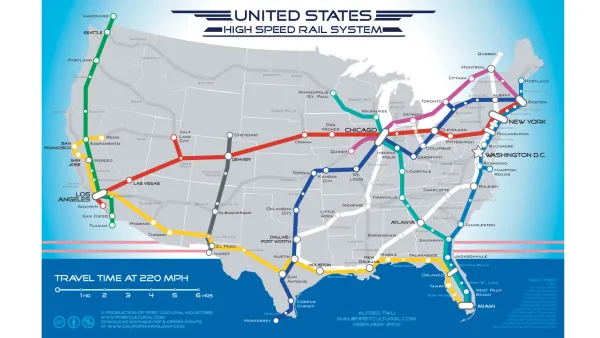
A huge boost for the CA High Speed Rail project will result from an injection of $2.25 billion from President Obama's $8 billion HSR stimulus funds, twice as much as any other project.


The huge grant, likely to be matched by the $9.95 billion Prop. 1A (2008) could not come at a better time. The CA High Speed Rail Authority has been hammered recently because of alleged shortcomings in its business plan.
"President Barack Obama will award the California high-speed train project a $2.25 billion stimulus grant today (Jan 28), a huge boost that virtually guarantees construction will begin in backyards along the Caltrain tracks within two and a half years.
The California High-Speed Rail Authority could match the grant with voter-approved Proposition 1A money.
Gov. Arnold Schwarzenegger in September applied for $4.6 billion in stimulus cash, including $1.28 billion for the section along the Caltrain tracks (from San Jose to San Francisco).
In all, 13 corridors in 31 states received funds. Obama timed the announcement to coincide with his State of the Union address and focus on job creation. The authority estimates that every $1 billion spent will generate about 20,000 jobs."
From Hundreds turns out at state Senate hearing in Palo Alto on high-speed rail:
"As the state bids for $4.7 billion in federal stimulus funding, it is pitching its high-speed rail project as the most "shovel-ready" in the nation, with groundbreaking possible by 2012. But a growing number of residents and officials on the Peninsula and elsewhere are calling on officials to hold the shovels. They say the project has not been well-planned and could be headed for financial ruin if oversight doesn't improve.
(State Senators) Simitian and Lowenthal have proven receptive to their concerns, pushing the California High Speed Rail Authority to address holes in its business plan in order to receive continued state funding. They pressed the authority on its latest plan, released in December, at a hearing Tuesday at the state Capitol."
Thanks to Lowell Grattan
Read the full story: High-speed train project gets $2.25 billion from Obama
High Speed Locomotive Contract for Five States Awarded to Siemans AG
A $226 million contract to build 32 higher speed diesel locomotives, capable of reaching 125 mph, was awarded to the team of the German conglomerate, Siemens AG and Indiana-based engine maker Cummins, Inc over Peoria, Ill. based Caterpillar, Inc.
Ray LaHood Stays On As Transportation Secretary
Ending speculation as to whether he would stay or announce his resignation as many in Obama's cabinet have done, and who would replace him should he depart, Ray LaHood announced informally he would stay on as Secretary of the Dept. of Transportation.
Nail-biter Vote In CA: State Senate Approves High Speed Rail
Without a vote to spare, the CA state senate voted to authorize $5.8 billion to begin construction in the Central Valley of the nation's first true HSR system. The assembly passed the bill earlier in the week.

Planetizen Federal Action Tracker
A weekly monitor of how Trump’s orders and actions are impacting planners and planning in America.

Eastern Nebraska is running out of electricity
Data centers and electrification are straining eastern Nebraska’s grid, throttling economic development.

Study reveals best places in the U.S. for cycling, walking
New research from Streetlight Data examines bicycle and pedestrian miles per capita in the 100 largest U.S. cities by population.

DSA members accuse Mamdani of 'abandoning values' over housing redevelopment
New York City's mayor plans to replace about 2,000 units of public housing with private, mixed-income housing.

All sides of BRT debate unhappy with CDOT’s most recent move
The Colorado Department of Transportation is no longer considering center-running bus lanes for Colorado Boulevard.

Massachusetts bogs generate both power, and cranberries
Putting solar panels above farmland is one way Massachusetts is advancing toward its goal of net-zero carbon emissions by 2050.

FREE Course: Walkable City 1: Why Walkability?
After describing his path towards focusing on walkability as the essence of good planning, Jeff Speck marches through his five principal reasons for making more walkable places.
Reinventing Malls: Planning Alchemy—Turning Gray Fields Into Gold
The course focuses on the opportunities and imperatives that shape reinvention of mall sites.

City of Rosemead
Rutgers University, Edward J. Bloustein School of Planning and Public Policy
One Hundred Miles
University of Michigan School for Environment and Sustainability (SEAS)
Hunter College, City University of New York (CUNY)
The Architects Foundation
City of Cambridge
The Pocatello Development Authority
The Urban Renewal Agency of the City of Pocatello