Large homebuilders, including Pulte Homes and Hovnanian Enterprises, will recieve hundreds of millions of taxpayer dollars under the recently passed Worker, Homeownership and Business Assistance Act of 2009.


Gretchen Morgenson writes in the New York Times:
"One can make an argument that throwing money at the banking system is necessary if we are to jump-start the economy. And banks need a bigger capital cushion to protect against future losses.
But dropping helicopter money on the home builders - the folks who massively overbuilt in community after community - seems decidedly less urgent (unless you are one of these companies, of course). Given that the supply of housing far outstrips demand, it is unlikely that these companies will use these tax breaks to hire workers (unless they go into a completely new line of business)."
Thanks to Heather Rose
Read the full story: Home Builders (You Heard That Right) Get a Gift
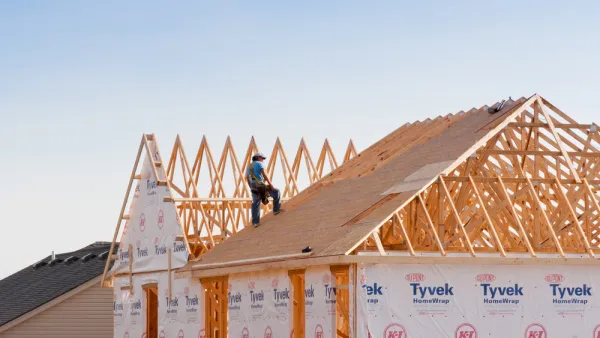
Housing Construction More and More Frequently the Product of Two Companies
The history of U.S. housing construction has traditionally been the story of many companies building a few homes a year. Now two companies alone are out-building the rest of the top ten homebuilders combined.
High Housing Prices Concern the Nation's Homebuilders
High prices and rising mortgage rates are called a "toxic cocktail" for the homebuilding industry.
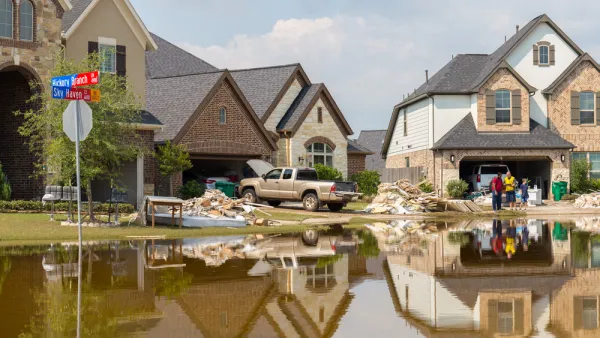
A Year After Harvey, Homes Still Going Up on Houston Flood Plain
Despite the devastation wrought by Hurricane Harvey, builders and buyers alike are sustaining a market for new construction on land likely to get flooded again.

Planetizen Federal Action Tracker
A weekly monitor of how Trump’s orders and actions are impacting planners and planning in America.

Eastern Nebraska is running out of electricity
Data centers and electrification are straining eastern Nebraska’s grid, throttling economic development.

Study reveals best places in the U.S. for cycling, walking
New research from Streetlight Data examines bicycle and pedestrian miles per capita in the 100 largest U.S. cities by population.

DSA members accuse Mamdani of 'abandoning values' over housing redevelopment
New York City's mayor plans to replace about 2,000 units of public housing with private, mixed-income housing.

All sides of BRT debate unhappy with CDOT’s most recent move
The Colorado Department of Transportation is no longer considering center-running bus lanes for Colorado Boulevard.

Massachusetts bogs generate both power, and cranberries
Putting solar panels above farmland is one way Massachusetts is advancing toward its goal of net-zero carbon emissions by 2050.

FREE Course: Walkable City 1: Why Walkability?
After describing his path towards focusing on walkability as the essence of good planning, Jeff Speck marches through his five principal reasons for making more walkable places.
Reinventing Malls: Planning Alchemy—Turning Gray Fields Into Gold
The course focuses on the opportunities and imperatives that shape reinvention of mall sites.

City of Rosemead
Rutgers University, Edward J. Bloustein School of Planning and Public Policy
One Hundred Miles
University of Michigan School for Environment and Sustainability (SEAS)
Hunter College, City University of New York (CUNY)
The Architects Foundation
City of Cambridge
The Pocatello Development Authority
The Urban Renewal Agency of the City of Pocatello