California Governor Schwarzenegger has ordered state officials to seek federal funding only for the state's high-speed rail project--at the expense of efforts to make Metrolink trains safer, some say.


"Eliminated from the state application for federal funds was almost $170 million for positive train control -- computer-guided braking systems designed to prevent collisions and allow conventional trains to safely travel at 110 mph. Such automated systems, which the federal government wants installed by 2015, would have prevented the Metrolink crash in Chatsworth last year that killed 25 people in the worst rail accident in modern California history."
"However, Richard Katz, a former assemblyman who sits on the Metrolink, high-speed rail and Metropolitan Transportation Authority boards, was more optimistic that conventional rail projects, such as positive train control, would not be jeopardized by the governor's concentration on high-speed rail.
For example, Katz said, Metrolink, which serves six counties, needs roughly $200 million to $210 million to install positive train control by 2012.
About $70 million has been requested from other federal sources, and efforts are underway to try to redirect $97 million from state transportation bonds that are earmarked to rebuild the Colton railroad crossing.
If positive train control cannot get enough federal or state funding, Katz said he believes the MTA would lend Metrolink the money.
'We are still in good shape overall,' Katz said. 'We're applying for everything we can get our hands on. I think we will do well in all our funding requests.'"
Read the full story: Schwarzenegger quietly quashed effort to improve commuter rails

China Railway Drops Out of L.A. to Las Vegas High-Speed Rail Project
China Railway, which had agreed to put up $100 million for XpressWest to build a 230-mile, 190 mph train from Victorville, Calif. to Las Vegas last September, withdrew from their agreement, primarily due to the inability to use their own trains.
Train Times to Accompany Motorists Stuck in Traffic
To encourage train ridership, Caltrans and Metrolink have teamed up to display train times on electronic signs along two oft-congested Southern California freeways.
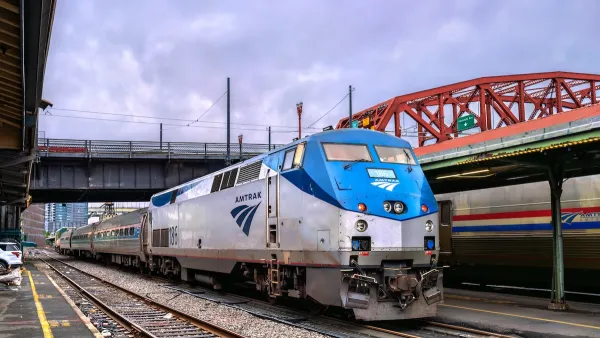
Transit leaders progress high-speed rail from Portland to Vancouver, B.C.
Washington state officials may reveal feasible routes for the high-speed rail in late 2027.

Planetizen Federal Action Tracker
A weekly monitor of how Trump’s orders and actions are impacting planners and planning in America.

Chicago breaks ground on $3 billion megadevelopment
The new neighborhood, titled Foundry Park, will one day host 3,700 residences.

This MA town is drowning in its own sewage — and residents like it that way
Susan Murcott, a waste water expert, said if Carlisle didn't address their leaking sewage, the problem could turn “deadly.”

Feds to more closely scrutinize proposed Amtrak facility’s environmental impact
The Federal Railroad Administration had initially said the facility qualified for a less extensive environmental review.

Boston is hard to build housing in: its chief of planning wants to keep it that way
Chief of Planning Kairos Shen said she would not make changes to Boston’s affordability requirements for new housing, which critics say have slowed down development.

California plans to bury El Niño’s downpour
If the state plays its cards right, it may be able to store a billion acre-feet of El Niño’s water in aquifers.

FREE Course: Walkable City 1: Why Walkability?
After describing his path towards focusing on walkability as the essence of good planning, Jeff Speck marches through his five principal reasons for making more walkable places.
Reinventing Malls: Planning Alchemy—Turning Gray Fields Into Gold
The course focuses on the opportunities and imperatives that shape reinvention of mall sites.

City of Rosemead
Rutgers University, Edward J. Bloustein School of Planning and Public Policy
One Hundred Miles
Hunter College, City University of New York (CUNY)
The Architects Foundation
University of Cincinnati Online
Montrose County
The Pocatello Development Authority
The Urban Renewal Agency of the City of Pocatello