Developers of Sterling Ranch, a proposed master-planned community in Colorado, want its future residents to curb their water use. One way they're ensuring this is by nixing traditional, lush lawns from their plans.


"Yards will be sunk down a couple inches below the sidewalk so they act as a bowl, soaking up moisture. Any runoff -- or rainwater -- that does hit the pavement will flow down into 55,000-gallon cisterns built under the streets. That water will be available to homeowners for outdoor irrigation. But it will be rationed tightly.
'You abuse exterior water use, we'll warn you, fine you, and then we will shut your water off,' says Jack Hoagland, another development partner. 'So sue us,' he says, chuckling. 'We'll take care of water hogs.'
All athletic fields in Sterling Ranch will be artificial turf. If the technology pans out, tall poles with photovoltaic panels on top may be planted in the bottom of the communal reservoir to act like giant parasols, shielding the stored water from evaporation.
All of which makes some neighbors uneasy. Nearly 400 have banded together to criticize the development. They are concerned about the added traffic and the visual clutter. But most of all, they worry about water.
Though the developers promise that drought-tolerant landscaping can be lush, neighbors fear it will look bleak and barren. They don't like the idea of artificial turf plunked down on their prairie. And they worry that future residents of Sterling Ranch will demand far more water than developers are budgeting, leaving other parts of the county high and dry."
Read the full story: In Arid West, Lawns Get Trimmed -- From Plans


Google will fund removal of 2000 acres of trees in Oklahoma to save water while building new data center
The company has invested $30 million into projects intended to address Oklahoma’s water shortage.

Rain gardens keep up to 99% of pollutants out of San Francisco Bay
The city's roadside rain gardens soak up stormwater and filter out dozens of harmful micropollutants.

Climate change could double household water costs in some cities, study finds
New research suggests that climate change-related stressors are straining municipal water systems.

Planetizen Federal Action Tracker
A weekly monitor of how Trump’s orders and actions are impacting planners and planning in America.

Northwest rail fans eager for Sept. 30 debut of Amtrak’s Airo fleet
Get ready for that new train smell and more seats. But they won’t go faster or run more frequently on the Cascades route in Washington and Oregon.
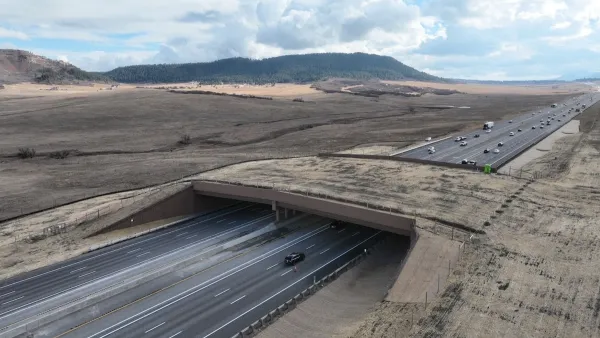
Record-breaking wildlife overpass in Colorado brings 91% reduction in animal collisions
Prior to the overpass, vehicles were hitting one deer per day on Colorado’s Interstate 25.

Detroit to transform waterfront with $2.2 billion investment
Developers will convert about 18 acres of unused parking lot space into civic spaces.

‘Going backwards:’ Baltimore mayor, students rally against state's transit funding plan
Maryland's proposed six-year plan provides no funding for Baltimore’s BMORE bus program and reduces its road maintenance funding.

Trump wants to cancel nearly 98% of funding for HUD housing support program
Multiple housing groups are suing the administration in an effort to preserve the funding.

FREE Course: Walkable City 1: Why Walkability?
After describing his path towards focusing on walkability as the essence of good planning, Jeff Speck marches through his five principal reasons for making more walkable places.
Reinventing Malls: Planning Alchemy—Turning Gray Fields Into Gold
The course focuses on the opportunities and imperatives that shape reinvention of mall sites.

City of Thousand Oaks
City of Wisconsin Rapids
Harvard University Graduate School of Design
The Architects Foundation
University of Cincinnati Online
Northern Illinois Transit Authority (NITA)
The Pocatello Development Authority
The Urban Renewal Agency of the City of Pocatello