The economic downturn has brought much development in Moscow to a halt. But for some preservationists, that's a good thing.


"[S]ome prominent Muscovites see a silver lining. They say the city has gotten a second chance to halt the breakneck destruction of its historic center, and replace the anything-goes building splurge of recent years with a plan to preserve Moscow's architectural heritage.
'During the past 15 years we've lost our Moscow,' says David Sarkisyan, director of the Shchusev State Museum of Architecture in Moscow. 'Something like 600 buildings, key pieces of the city's architectural cocktail, have been ruined, and 300 more are under threat. But, strange to say, the crisis is helping. All the city's main developers are bankrupt, and the bulldozers have been stilled for the time being.'"
By some accounts, only 5 percent of the city's historic buildings are still standing.
Read the full story: Moscow preservationists see silver lining in economic slump
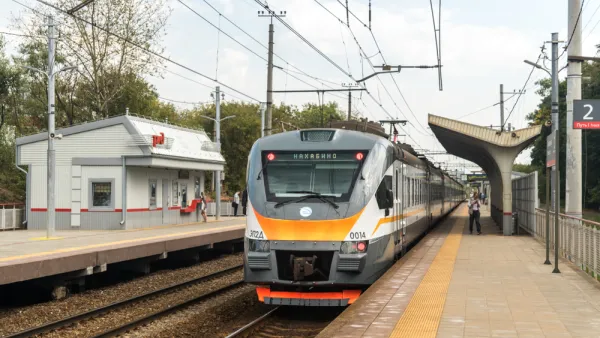
A New Suburban Rail System for Moscow
Two of a planned five new suburban rail routes, modeled on examples in Paris and Berlin, opened last week in Russia.

Muscovites Revolt Against Relocation Plan
Plans to decommission existing public housing blocks and replace them with newer high-rises has angered middle-class residents in Moscow who fear the loss of their homes and investments.
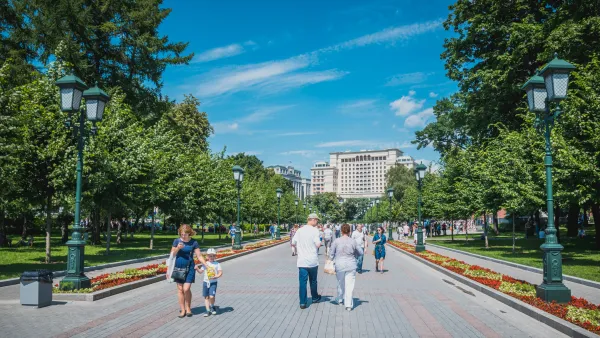
Moscow's Erratic Shift Towards a Walkable City
Moscow's Mayor has pushed an agenda to beautify the city, create social spaces, and make the city more walkable, but critics see the move towards walkability as more of a forced march.

Planetizen Federal Action Tracker
A weekly monitor of how Trump’s orders and actions are impacting planners and planning in America.

Eastern Nebraska is running out of electricity
Data centers and electrification are straining eastern Nebraska’s grid, throttling economic development.

Study reveals best places in the U.S. for cycling, walking
New research from Streetlight Data examines bicycle and pedestrian miles per capita in the 100 largest U.S. cities by population.

Federal government nominates new FTA administrator
Mark Aesch is currently the founder and CEO of a transportation management consulting firm.

Developers reveal $10 billion stadium plan as ‘Hail Mary’ to keep Bears in Chicago
The plan would also boast a public park, high- and mid-rise buildings and a youth sports complex.

As Texas embraces carbon storage, a Black community questions the risks
Texas now issues permits for companies to store carbon dioxide underground. East Texas residents fear safety risks, and skeptics doubt the climate benefits.

FREE Course: Walkable City 1: Why Walkability?
After describing his path towards focusing on walkability as the essence of good planning, Jeff Speck marches through his five principal reasons for making more walkable places.
Reinventing Malls: Planning Alchemy—Turning Gray Fields Into Gold
The course focuses on the opportunities and imperatives that shape reinvention of mall sites.

City of Charlotte
City of Rosemead
Rutgers University, Edward J. Bloustein School of Planning and Public Policy
University of Michigan School for Environment and Sustainability (SEAS)
Hunter College, City University of New York (CUNY)
The Architects Foundation
City of Cambridge
The Pocatello Development Authority
The Urban Renewal Agency of the City of Pocatello