The ailing auto industry has many manufacturers in the Midwest transitioning to the renewable energy market, opening factories to build wind turbine parts and solar panels.


"The promise of wind and other forms of renewable energy has cast a ray of hope into an otherwise bleak economy, especially in the industrial Midwest.
'A couple years ago, there weren't that many people interested,' says Edward Wolking, head of the Great Lakes Manufacturing Council. 'Now they're just beating doors down.'
For those hoping renewable-energy technologies will save the economy of the Midwest, there's a long way to go."
The void left by the auto industry doesn't look to be filled any time soon by the renewable energy industry, but strong growth and increased demand are offering signs of hope for manufacturers.
Read the full story: Can wind power save the Midwest?

Swapping your gas car for an EV is greener than keeping it, research shows
An EV repays the 'carbon debt' caused by building it after 4,400 miles.
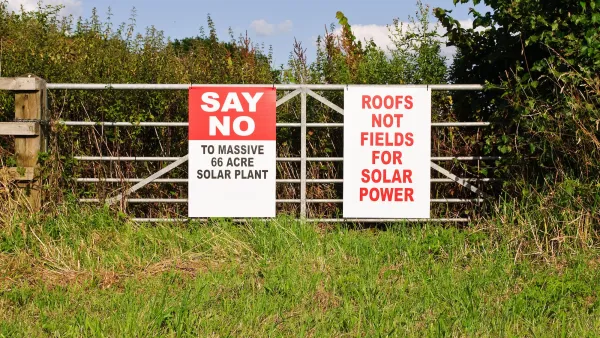
Misinformation and 'AI slop' are hamstringing rural solar development
False claims about the potential drawbacks of solar farms are prompting some communities to reject potentially lucrative energy projects.
Court unfreezes $20B in federal climate grants
A U.S. Court of Appeals ruled that the Trump administration potentially violated the Inflation Reduction Act by attempting to claw back grants awarded under the Greenhouse Gas Reduction Fund program.

Planetizen Federal Action Tracker
A weekly monitor of how Trump’s orders and actions are impacting planners and planning in America.

California plans to bury El Niño’s downpour
If the state plays its cards right, it may be able to store a billion acre-feet of El Niño’s water in aquifers.

Desperate measures: Advocates weigh draining Lake Powell to fill Colorado River
Draining the reservoir could reduce evaporation losses by a couple hundred thousand acre-feet.

Housing is the top priority of Seattle’s sole new councilmember
Jenks campaigned on building 1,000 new units of affordable housing.

New tax cuts may slash $1.5 billion in funding for Miami transit, public parks
Amendment 3 will save Miami-Dade homeowners $2,700 in 2028.

Arizona, Wisconsin, Pennsylvania hope to finally advance climate goals post-midterms
The three states have spent years under Republican or divided control.

FREE Course: Walkable City 1: Why Walkability?
After describing his path towards focusing on walkability as the essence of good planning, Jeff Speck marches through his five principal reasons for making more walkable places.
Reinventing Malls: Planning Alchemy—Turning Gray Fields Into Gold
The course focuses on the opportunities and imperatives that shape reinvention of mall sites.

City of Rosemead
Rutgers University, Edward J. Bloustein School of Planning and Public Policy
One Hundred Miles
University of Michigan School for Environment and Sustainability (SEAS)
Hunter College, City University of New York (CUNY)
The Architects Foundation
City of Cambridge
Montrose County
The Pocatello Development Authority