The recession is causing San Francisco to tighten its belt. Budget cuts are falling heavily on the city's health and human services.


"To close a projected $438 million shortfall, Mayor Gavin Newsom – who is campaigning for the 2010 governor's race – has proposed a "target" of 25 percent cuts to all city departments, including large reductions to health and human service programs that, combined with deep midyear spending cuts, mean the closure of some popular antipoverty programs this July 1."
"While such belt-tightening is hardly unique to San Francisco, the cuts have many asking if this iconic "Left Coast" city has moved to the right of the federal government, which is spending nearly $1 trillion to revive the economy. San Francisco's reputation for benevolence was affirmed by a recent city controller's report, which found that the city far outstrips its California counterparts in per capita spending on public health and social services."
"The cuts run counter to 'what this city ought to be – a caring city, caring for the people who live in this city and caring for people who serve this city,' said Damita Davis-Howard, president of the Service Employees International Union's municipal workers local, at a recent City Hall protest of about 700 city workers. 'People are losing their houses, people are losing their savings, their retirement, and it's the services in San Francisco that help those people in crisis.'"
FULL STORY: Amid recession, is San Francisco losing its heart?

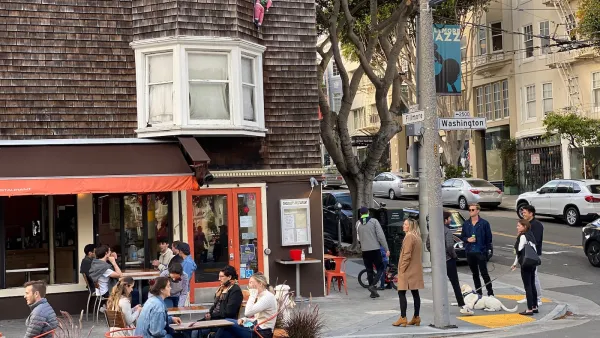
San Francisco leaders shelve proposed patio smoking ban
Facing backlash from business owners, supervisors postponed a discussion of legislation that would bar smoking from restaurant and bar patios.

San Francisco weighs patio smoking ban
Business owners say the ban could force patrons onto sidewalks and disrupt long-standing bar culture, while proponents of the ordinance say second-hand smoke is a threat to patrons and workers.

Post-Pandemic Transit Plan Announced in San Francisco
The recently announced post-COVID plan for public transit in San Francisco looks a lot different than the pre-COVID days.

Planetizen Federal Action Tracker
A weekly monitor of how Trump’s orders and actions are impacting planners and planning in America.

The state-sanctioned urbicide of Austin
People don’t kill cities. Freeways do.

US to reduce Colorado River water deliveries to Mexico
A new Colorado Treaty amendment reduces Mexico’s Colorado River water allocation by 250,000 acre feet.

5 New England states march closer to 800 megawatt wind energy project
Securing federal approval for the project may be complicated under the Trump administration, which has historically been hostile towards domestic wind power.

Baltimore to break ground on $50 million Transit Priority Project
The project will bring faster bus trips, safer streets and better bike connections to Baltimore.

Airbnb launches $250 million 'last-dollar financing' housing accelerator, makes first investment in Austin
The company will put $6.4 million towards affordable housing development in Texas’ capital.

FREE Course: Walkable City 1: Why Walkability?
After describing his path towards focusing on walkability as the essence of good planning, Jeff Speck marches through his five principal reasons for making more walkable places.
Reinventing Malls: Planning Alchemy—Turning Gray Fields Into Gold
The course focuses on the opportunities and imperatives that shape reinvention of mall sites.

Eagle County Government
Harvard University Graduate School of Design
Nashville Planning Department
The Architects Foundation
University of Cincinnati Online
The Pocatello Development Authority
The Urban Renewal Agency of the City of Pocatello
Journal of the American Planning Association