The city council of Vancouver is supporting the creation of 550 temporary homes, including some prefab, to house the area's homeless.


"The modular housing component was based on proposals from architect Gregory Henriquez and real estate consultant Michael Geller, who suggested the idea during Geller's unsuccessful council bid in last fall's municipal election.
The province asked Geller to study the feasibility of the modular concept and he concluded that the idea was a practical one. Geller said capital costs would vary between $37,000 and $46,000 per unit, compared to $302,000 for permanent units already announced by the province.
'One of the true benefits of this approach is that we can have people housed in a matter of months rather than a matter of years,' said Geller.
'While some may be concerned that this housing will not be attractive, I think the plans produced to date clearly demonstrate that a great concern may be that it's too attractive and hence will become permanent.'"
Read the full story: City council backs plan for prefab housing
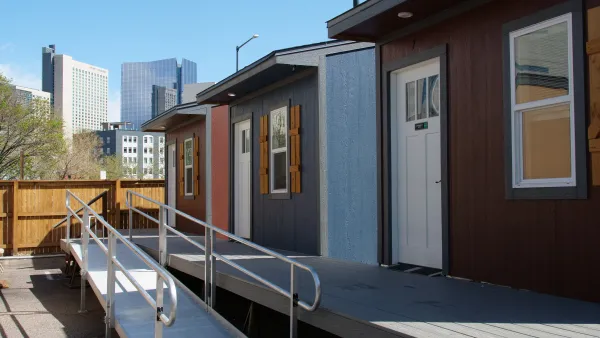
Denver is solving homelessness. Why aren't the rest of us?
Since 2023, Denver's street homeless population has decreased by 64%, proving that effective tools exist to support those in need of housing.
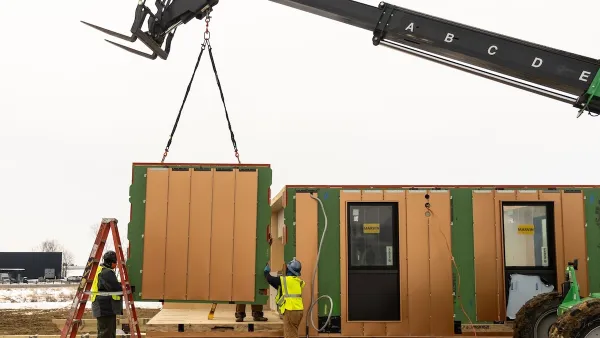
Commentary: New Bill Holds Key to Solving US Housing Crisis. We Just Have to Pass It.
Two bills currently moving through Congress could make mass production of prefabricated, affordable housing possible on a large scale.
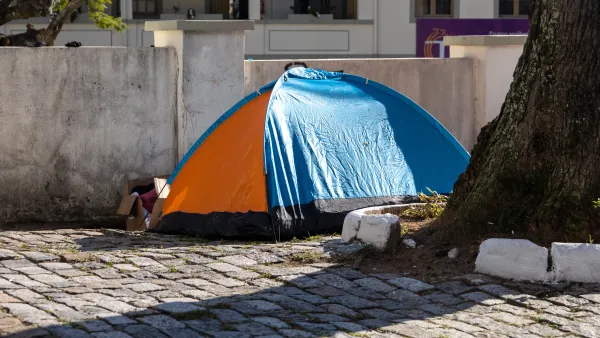
U.S. Supreme Court Upholds Camping Bans, but Challenges of Addressing Homelessness Remain
In Grants Pass v. Johnson, the Supreme Court upheld an Oregon city’s ban on camping in public places, paving the way for similar bans in cities across the country but doing nothing to solve the cause of homelessness.

Desperate measures: Advocates weigh draining Lake Powell to fill Colorado River
Draining the reservoir could reduce evaporation losses by a couple hundred thousand acre-feet.

Eastern Nebraska is running out of electricity
Data centers and electrification are straining eastern Nebraska’s grid, throttling economic development.

Move over, LA: St. Louis gears up for Olympics, invests millions in downtown redevelopment
The Missouri city will host the 2028 Olympic soccer group stage and knockout matches.

Mass. votes against statewide minimum lot size for single-family homes
Over 2 million residents voted on Question 7; it was decided by just over 30,000 votes.

Maryland’s $15 billion bridge project gains key approval
The Maryland Transit Authority said the project will create over 60,000 jobs and add $23 billion to the local economy.

‘No clear next steps’ for Chicago's permanent festival grounds
Eleventh Ward Ald. Nicole Lee has suggested Soldier Field as a possible location for the permanent event space.

FREE Course: Walkable City 1: Why Walkability?
After describing his path towards focusing on walkability as the essence of good planning, Jeff Speck marches through his five principal reasons for making more walkable places.
Reinventing Malls: Planning Alchemy—Turning Gray Fields Into Gold
The course focuses on the opportunities and imperatives that shape reinvention of mall sites.

City of Rosemead
Rutgers University, Edward J. Bloustein School of Planning and Public Policy
One Hundred Miles
University of Michigan School for Environment and Sustainability (SEAS)
Hunter College, City University of New York (CUNY)
The Architects Foundation
City of Cambridge
Montrose County
The Pocatello Development Authority