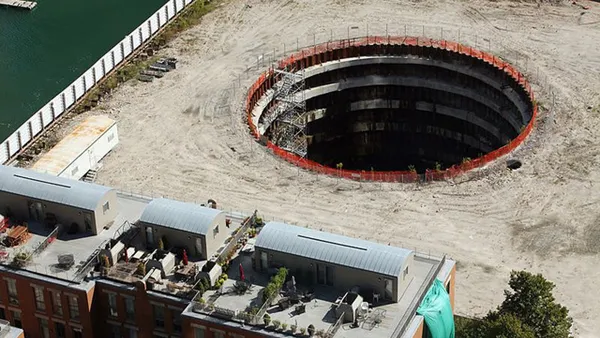
No work has been done on the Chicago Spire, the city's latest planned skyscraper, since the credit market froze up in January. A brief look at the blow to the building industry, in which joblessness is at a rate of 21.4%.


"The recently passed U.S. economic stimulus bill was expected to funnel $150 billion into building and repairing infrastructure, which the union said would employ 700,000 workers, for a while. The stimulus funding is viewed as only a downpayment on the $2.2 trillion engineers say is needed to rebuild the nation's infrastructure. Fewer workers are needed to perform maintenance than build from scratch, labourers say.
'If there's no buildings going up, what do you do?' said James Connolly, a Labourers' union manager. 'Prepare yourself because it's going to get worse before it gets better.'
Construction workers are accustomed to boom-and-bust cycles but this downturn appears deeper and longer. The impact of lost wages of $35 to $40 an hour ripples through the economy."
Read the full story: Global recession stalls skyscraper construction

20 Years After 9/11: The 'Age of Skyscrapers' Is Nowhere Near Over
Despite predictions that the events of September 11, 2001 would be the end of skyscrapers, U.S. cities are building more tall buildings than ever.
Two Skyline Changing Apartment Towers Proposed to Rise on the Site of Chicago's Failed Spire
An infamous site has new development life after developers returned to the public with a revised project proposal.

Developers Seeking Approval for Chicago's Second Tallest Skyscraper
A skyscraper proposed for land formerly owned by Tribune Media has been redesigned to assuage the concerns of neighbors.

Planetizen Federal Action Tracker
A weekly monitor of how Trump’s orders and actions are impacting planners and planning in America.

Eastern Nebraska is running out of electricity
Data centers and electrification are straining eastern Nebraska’s grid, throttling economic development.

Washington state to charge fee to drivers with fuel-efficient cars
Revenue from the fee will go towards supporting the state’s highways.

Instead of building new housing, LA developers are turning mansions into mega-mansions
In the richest areas, the number of houses valued at $30 million with demolition permits has skyrocketed since 2018.

Illinois considers spending $1 billion in taxpayer money on data center
A quantum computing campus and data center are currently under construction in Chicago.

As development costs rise, Boston moves to lessen affordable housing requirements
The Boston Zoning Commission and the City Council still need to approve Boston Mayor Michelle Wu’s proposed changes

FREE Course: Walkable City 1: Why Walkability?
After describing his path towards focusing on walkability as the essence of good planning, Jeff Speck marches through his five principal reasons for making more walkable places.
Reinventing Malls: Planning Alchemy—Turning Gray Fields Into Gold
The course focuses on the opportunities and imperatives that shape reinvention of mall sites.

City of Charlotte
City of Rosemead
Rutgers University, Edward J. Bloustein School of Planning and Public Policy
University of Michigan School for Environment and Sustainability (SEAS)
Hunter College, City University of New York (CUNY)
The Architects Foundation
University District Partnership
City of Cambridge
The Pocatello Development Authority