Jeff Speck takes a walk in Oklahoma City and finds too-wide streets, too-low density and too much danger for pedestrians.


"Streets getting the most critical eye from Speck include Hudson Avenue between Reno Avenue and Robert S. Kerr Avenue. Those trying to cross the six-lane street Thursday included Henry Jerome, 34, who was on his way to the Oklahoma County Courthouse."
"'This is why I don't come downtown,' Jerome said. 'I thought parking would be bad, but it really wasn't. But this street - it's ridiculous. And all these one-way streets are scary. Why does it have to be this way?'"
"According to Speck, it doesn't. Speck showed the downtown street configurations to traffic engineers outside the state and their first response was to guess the street grid was set up for a downtown density and traffic volume comparable to Chicago or Manhattan."
"'They said this is a street network that will support three to four times the density it is handling,' Speck said. 'Then you look at the traffic counts, and only a few carrying 10,000 a day. And 10,000 cars a day is easily handled by a two-lane road.'"
Thanks to ArchNewsNow
Read the full story: Oklahoma City streets not made for walking, design consultant concludes

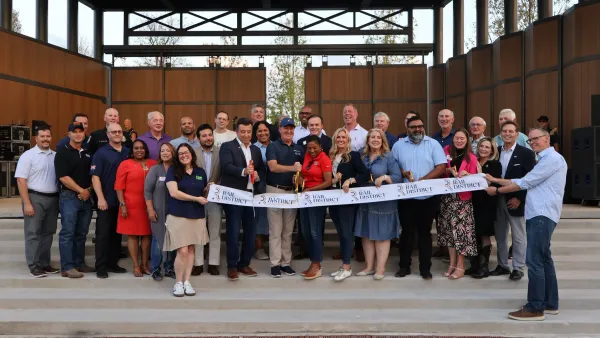
Dallas suburbs are turning their downtowns into small towns
Four Texas towns are embracing walkability and density in their downtowns.
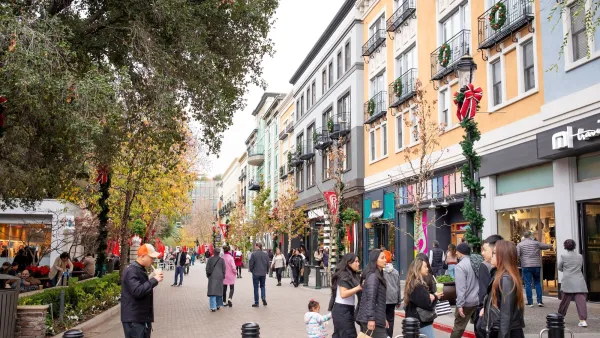
Survey: Americans want walkable amenities, but not dense housing
While 64% of Americans say they want walkable amenities, only 44% want to see apartments in their neighborhoods.
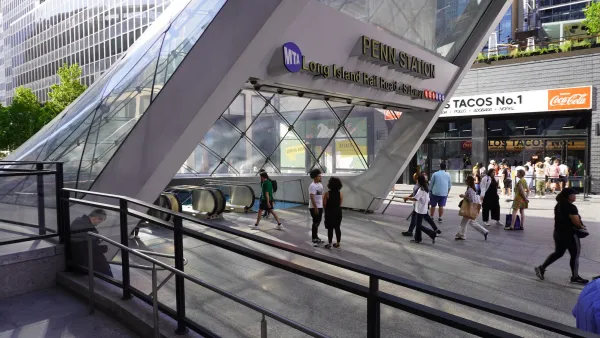
Which US cities have the most housing near transit?
Concentrating housing near frequent, reliable transit offers advantages to both residents and transit agencies, who can serve more riders more efficiently.

Planetizen Federal Action Tracker
A weekly monitor of how Trump’s orders and actions are impacting planners and planning in America.

California plans to bury El Niño’s downpour
If the state plays its cards right, it may be able to store a billion acre-feet of El Niño’s water in aquifers.

Chicago breaks ground on $3 billion megadevelopment
The new neighborhood, titled Foundry Park, will one day host 3,700 residences.

California High-Speed Rail Authority CEO resigns after $600,000 scandal
Under Ian Choudri, the authority used taxpayer dollars to fund first class flights and trips to nightclubs.

Want to study the Missouri River? Soon, you may need unanimous approval from 10 states
Legislation would require 10 governors’ permission to study or build projects moving water outside the basin.

Desperate measures: Advocates weigh draining Lake Powell to fill Colorado River
Draining the reservoir could reduce evaporation losses by a couple hundred thousand acre-feet.

FREE Course: Walkable City 1: Why Walkability?
After describing his path towards focusing on walkability as the essence of good planning, Jeff Speck marches through his five principal reasons for making more walkable places.
Reinventing Malls: Planning Alchemy—Turning Gray Fields Into Gold
The course focuses on the opportunities and imperatives that shape reinvention of mall sites.

City of Rosemead
Rutgers University, Edward J. Bloustein School of Planning and Public Policy
One Hundred Miles
Hunter College, City University of New York (CUNY)
The Architects Foundation
University of Cincinnati Online
City of Cambridge
Montrose County
The Pocatello Development Authority