Prisons around the country are looking less and less like the typical concrete box; Washington state has 34 LEED-certified prisons, some of which offer "green work" programs.


"This fall, the California Department of Corrections and Rehabilitation announced 16 new green retrofitting projects, which they estimate will save $3 million in energy costs each year. The state already has solar power fields at two facilities, and plans to build six more in the coming year. A new $176 million juvenile detention facility in Alameda County - home to Berkeley and Oakland - recently became the country's first jail to receive LEED gold certification.
Other green projects - from wind turbines to biomass boilers - have been announced by Departments of Corrections in Virginia, Nevada and Indiana.
Mike Callahan, the physical plant director at the Putnamville Correctional Facility in Indiana, says the facility's biomass boiler alone, which burns scrap wood from the prison's pallet industry, has saved $6,300 a day in gas bills."
Read the full story: Greening the Prison-Industrial Complex
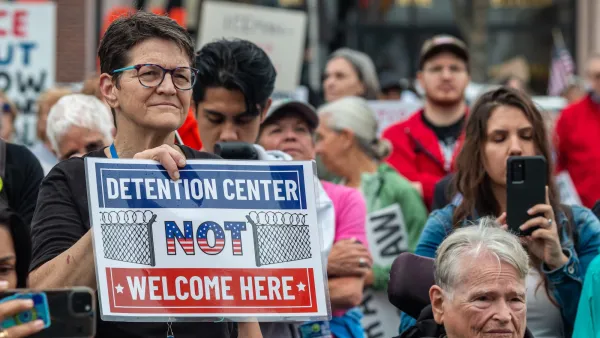
Land use as protest: How American cities are fighting federal immigration detention centers
Across the country, city officials are using zoning codes and land use law to limit where ICE detention facilities can be built.
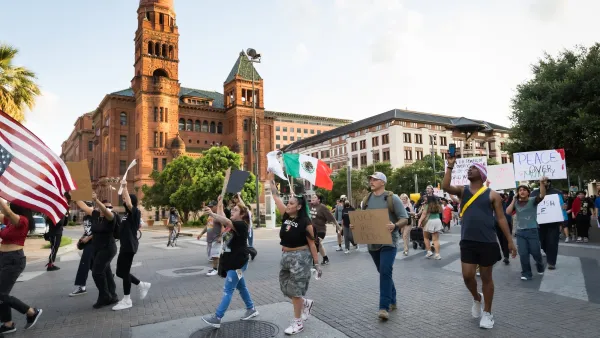
San Antonio sets new rules for immigration detention facilities
The city revised its zoning code to add new restrictions for private detention centers, but the ordinance won't apply to federally operated facilities.
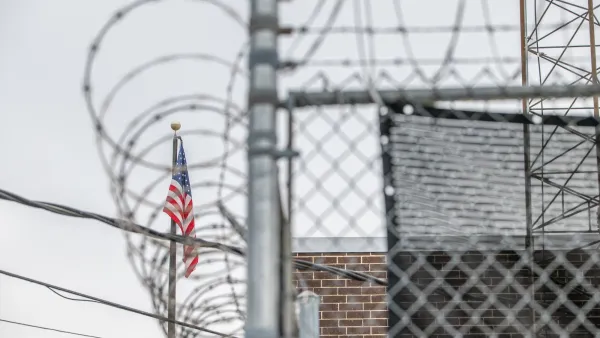
Architecture Firm to Stop Designing ICE Prisons After Staff Outrage
Employees of one of the nation’s largest “justice facility” firms called on their company to end contracts for detention facilities.

Planetizen Federal Action Tracker
A weekly monitor of how Trump’s orders and actions are impacting planners and planning in America.

Eastern Nebraska is running out of electricity
Data centers and electrification are straining eastern Nebraska’s grid, throttling economic development.

Study reveals best places in the U.S. for cycling, walking
New research from Streetlight Data examines bicycle and pedestrian miles per capita in the 100 largest U.S. cities by population.

DSA members accuse Mamdani of 'abandoning values' over housing redevelopment
New York City's mayor plans to replace about 2,000 units of public housing with private, mixed-income housing.

All sides of BRT debate unhappy with CDOT’s most recent move
The Colorado Department of Transportation is no longer considering center-running bus lanes for Colorado Boulevard.

Massachusetts bogs generate both power, and cranberries
Putting solar panels above farmland is one way Massachusetts is advancing toward its goal of net-zero carbon emissions by 2050.

FREE Course: Walkable City 1: Why Walkability?
After describing his path towards focusing on walkability as the essence of good planning, Jeff Speck marches through his five principal reasons for making more walkable places.
Reinventing Malls: Planning Alchemy—Turning Gray Fields Into Gold
The course focuses on the opportunities and imperatives that shape reinvention of mall sites.

City of Rosemead
Rutgers University, Edward J. Bloustein School of Planning and Public Policy
One Hundred Miles
University of Michigan School for Environment and Sustainability (SEAS)
Hunter College, City University of New York (CUNY)
The Architects Foundation
City of Cambridge
The Pocatello Development Authority
The Urban Renewal Agency of the City of Pocatello