In Rohnert Park, CA, developers are turning a former industrial site into a green community that is almost completely energy independent. But can a project like this fit into an auto-oriented suburb?


"Greg Searle, executive director of BioRegional North America, admits that they can't control the environmental impact residents will have when they leave the development. But the development company has done an enormous amount to improve the efficiency of the systems within the Sonoma Mountain Village, meeting the small community's water, energy and transportation needs with state-of-the-art green features like on-site renewable energy. BioRegional asserts that "every resident is no more than a five-minute walk to groceries, restaurants, day care and other amenities offering local, sustainable, and fair trade products and services."
The village center, which was designed around the reuse of existing buildings, will include a year-round farmers market, grocery stores and other businesses, entertainment options, and telecommuting desks. Alternative transportation services will be plentiful: free bikes, electric vehicles that connect to the smart grid, a biofuel filling station, plug-in hybrid carshare, and carpool concierge services. Thanks in part to lobbying by Codding, a commuter rail line linking the suburb to nearby cities has also been approved, and will be a ten-minute walk from the community."
Read the full story: Sonoma Mountain Village: Is Green Suburbia Possible?

First Wind Energy Farm Blows Into the Southeast
Elizabeth City, North Carolina, will host a 204-megawatt wind energy facility—the first in a region known for steady coastal breezes. The project is a collaboration of European-based Iberdrola Renewables, LLC, and Seattle-based Amazon.

Swapping your gas car for an EV is greener than keeping it, research shows
An EV repays the 'carbon debt' caused by building it after 4,400 miles.

Climate change could double household water costs in some cities, study finds
New research suggests that climate change-related stressors are straining municipal water systems.

Planetizen Federal Action Tracker
A weekly monitor of how Trump’s orders and actions are impacting planners and planning in America.

‘Going backwards:’ Baltimore mayor, students rally against state's transit funding plan
Maryland's proposed six-year plan provides no funding for Baltimore’s BMORE bus program and reduces its road maintenance funding.
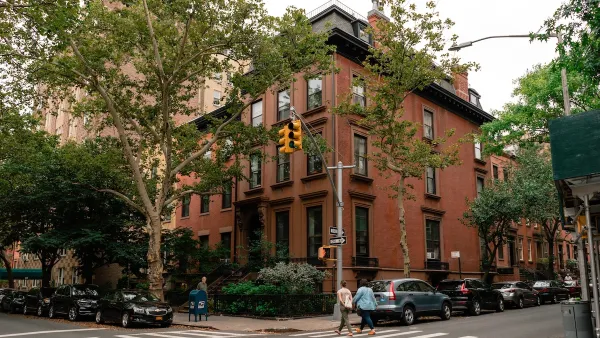
Mamdani sent nearly 6,000 pied-à-terre tax warnings to homes that didn’t qualify
A judge has ordered the administration to cancel thousands of pied-à-terre tax notices after it sent 35% of them erroneously.

Mamdani sent nearly 6,000 pied-à-terre tax warnings to homes that didn’t qualify
A judge has ordered the administration to cancel thousands of pied-à-terre tax notices after it sent 35% of them erroneously.

Detroit to transform waterfront with $2.2 billion investment
Developers will convert about 18 acres of unused parking lot space into civic spaces.

‘Going backwards:’ Baltimore mayor, students rally against state's transit funding plan
Maryland's proposed six-year plan provides no funding for Baltimore’s BMORE bus program and reduces its road maintenance funding.

FREE Course: Walkable City 1: Why Walkability?
After describing his path towards focusing on walkability as the essence of good planning, Jeff Speck marches through his five principal reasons for making more walkable places.
Reinventing Malls: Planning Alchemy—Turning Gray Fields Into Gold
The course focuses on the opportunities and imperatives that shape reinvention of mall sites.

City of Thousand Oaks
City of Wisconsin Rapids
Harvard University Graduate School of Design
The Architects Foundation
University of Cincinnati Online
Northern Illinois Transit Authority (NITA)
The Pocatello Development Authority
The Urban Renewal Agency of the City of Pocatello