In this op-ed, Michael Andregg touts Personal Rapid Transit over 'financially unsustainable' light rail, which he blames politicians for encouraging.


"The old technology was light rail and the new technology Personal Rapid Transit, or PRT. Engineers at the U showed that PRT could do a superior job for about a third of the cost in energy and money compared to buses and trains, including "light" trains. It could do this because it involves very light electric vehicles carrying only one to three passengers on nonstop, one-way trips above existing transportation grids on 3-foot diameter guideways. They showed that PRT could operate 24 hours a day over entire areas rather than be confined to schedules on high-density corridors because it requires no drivers and that it could be built without tearing up neighborhoods or businesses for years. Per mile, it would cost about one-tenth as much to build as light rail.
These are not 'hard numbers' but careful estimates, because vested interests quickly got a provision written into law forbidding consideration of any technology not fully proven. Engineers and the U wanted to prove it.
But that requires permission from politicians, and 'light' rail was busy spending millions to prepare the political ground for their old streetcar technology. Some among them recognized the peril the new PRT represented to their selfish interests. They could not hold our region hostage to a system that requires vast annual subsidies to operate if the U's invention became well known. So they did all they could to strangle it in the crib."
Read the full story: Fascination with trains costs Minnesota plenty

A Carbon-Neutral City?
A region known more for carbon emissions strives to create a carbon-neutral city powered by renewable energy and designed to reduce overall energy demand.
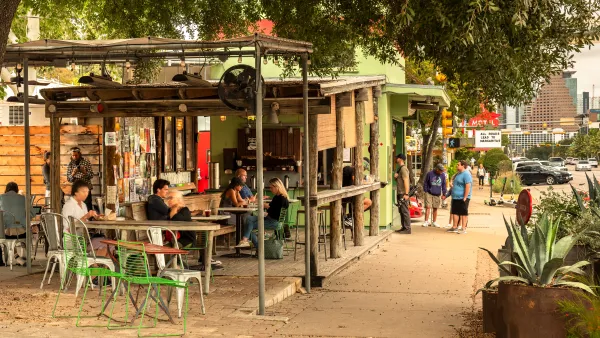
Large projects near Austin's light rail must include affordable housing
Elsewhere in the city, developers can pay into a city bank account for affordable housing rather than providing the required affordable units within their projects.

Budget constraints threaten light rail for Oregon, Washington’s new bridge
The current proposal includes only the infrastructure for the light rail, without funding for the train and tracks.

Planetizen Federal Action Tracker
A weekly monitor of how Trump’s orders and actions are impacting planners and planning in America.

Amtrak, CN end decades-long dispute with eight-year agreement
The new operating agreement establishes an updated framework for the companies to work together, including processes to resolve disputes.

Judges permit Denver to divert 77,000 acre feet from the Colorado River for reservoir expansion
Overuse and climate change have caused the Colorado River’s water levels to plummet.

NYC DOT wants faster, more permanent street upgrades
The city is examining ways to build more concrete infrastructure without getting entangled in 'decades-long' projects.

'Something we’ve never seen before:' rising utility rates could strain city finances nationwide
Data centers, climate change and other factors have caused utility rates in the United States to increase by 38% since 2020.

Trump to overrule local leaders, lease millions of acres of America’s Pacific Island territories’ seafloors to mining companies
International law says that the Indigenous people of America’s territories have a right to prior and informed consent regarding projects that impact their countries.

FREE Course: Walkable City 1: Why Walkability?
After describing his path towards focusing on walkability as the essence of good planning, Jeff Speck marches through his five principal reasons for making more walkable places.
Reinventing Malls: Planning Alchemy—Turning Gray Fields Into Gold
The course focuses on the opportunities and imperatives that shape reinvention of mall sites.

Harvard University Graduate School of Design
KFH Group Inc.
Greater Baltimore Committee
The Architects Foundation
University of Cincinnati Online
The Pocatello Development Authority
The Urban Renewal Agency of the City of Pocatello