For decades, people have been talking about how driverless cars would make highway traffic a thing of the past. Randal O'Toole asks, where are they?


"The obstacles to driverless cars, says General Motors vice president of research Larry Burns, are institutional, not technical. The biggest institutional problem is known as the chicken-and-egg problem: In order to have driverless cars, both the owners of the cars and the owners of the highways have to make an investment. Neither are likely to do so until the other one acts first.
The Antiplanner would like to solicit the help of both faithful allies and loyal opponents in solving this problem. I am particularly seeking solutions that require minimal government involvement yet introduce the benefits of driverless cars as fast as possible.
You can make jokes about computers crashing and so forth. But if your car was made in the last 20 or so years, it already has lots of computer processors in it, and they are probably among the most reliable parts of your car. Since each processor has a single, dedicated job, it is much less prone to error than personal computers that must deal with all of the different kinds of sometimes poorly written software users load on their machines."
FULL STORY: Dude, Where’s My Driverless Car?

Driverless Cars are the Solution, Says Randal O'Toole
Promoting his upcoming book on transportation planning, Randal O'Toole says his central argument is that rail is a dead end and driverless car technologies are the answer to our congestion problems.
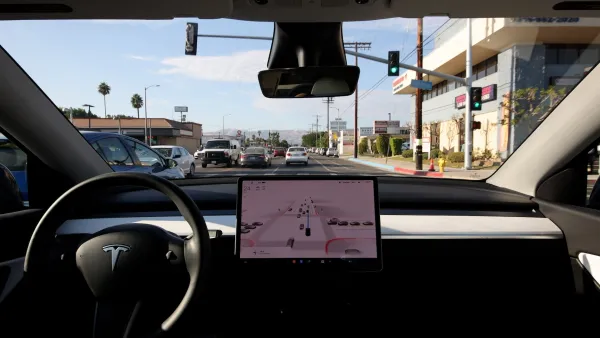
Tesla Launches Unsupervised Robotaxis in Austin
The company has been operating autonomous taxis with human safety drivers in the car in Austin since last June.
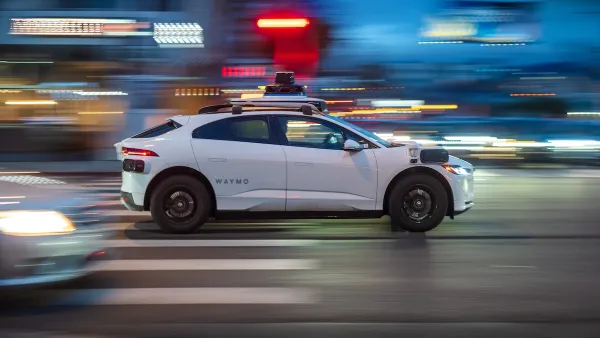
Seattle's Plan for Adopting Driverless Cars
Equity, safety, accessibility and affordability are front of mind as the city prepares for robotaxis and other autonomous vehicles.

Planetizen Federal Action Tracker
A weekly monitor of how Trump’s orders and actions are impacting planners and planning in America.

The state-sanctioned urbicide of Austin
People don’t kill cities. Freeways do.

US to reduce Colorado River water deliveries to Mexico
A new Colorado Treaty amendment reduces Mexico’s Colorado River water allocation by 250,000 acre feet.

5 New England states march closer to 800 megawatt wind energy project
Securing federal approval for the project may be complicated under the Trump administration, which has historically been hostile towards domestic wind power.

Baltimore to break ground on $50 million Transit Priority Project
The project will bring faster bus trips, safer streets and better bike connections to Baltimore.

Airbnb launches $250 million 'last-dollar financing' housing accelerator, makes first investment in Austin
The company will put $6.4 million towards affordable housing development in Texas’ capital.

FREE Course: Walkable City 1: Why Walkability?
After describing his path towards focusing on walkability as the essence of good planning, Jeff Speck marches through his five principal reasons for making more walkable places.
Reinventing Malls: Planning Alchemy—Turning Gray Fields Into Gold
The course focuses on the opportunities and imperatives that shape reinvention of mall sites.

Eagle County Government
Harvard University Graduate School of Design
Nashville Planning Department
The Architects Foundation
University of Cincinnati Online
The Pocatello Development Authority
The Urban Renewal Agency of the City of Pocatello
Journal of the American Planning Association