This editorial looks at the hostile environment of bicycling on much of Long Island, and ties it to the precarious life of many immigrant laborers, who already suffer from apparent hate crimes. Sadly, riding a bike only increases their vulnerability


"A well-worn landscape like Long Island's yields few surprises to the driver's gaze. Shops cluster by size and species: pizza with bagels and nail salons, Home Depot with Old Navy. But one roadside incongruity that always unnerves me is the sight of a person outside the shell of a car on purpose - like a man pedaling slowly beside a highway on a bicycle.
Bicyclists and suburbs are an uneasy fit. I don't mean the racing bikers who swarm like neon-colored beetles, hogging the middle of the road. I'm talking about the guys without helmets, on beat-up mountain bikes: restaurant workers wearing windbreakers over white dress shirts and ties; men in sweatshirts and baseball caps riding home from the store, plastic shopping bags hanging awkwardly off the handlebars.
Such sights are evidence of a valiant adaptation to a hostile environment. For immigrant workers, as with so many of us in the suburbs, life boils down to the job, the bed and the travel between. But when you live in a landscape designed for cars, and you are poor, and it is too far to walk to work, and there's no bus to take you there, the only option is two wheels. This is what is cheap and effective. It can also be deadly."
Thanks to Gladwyn d'Souza
FULL STORY: Men on Bicycles

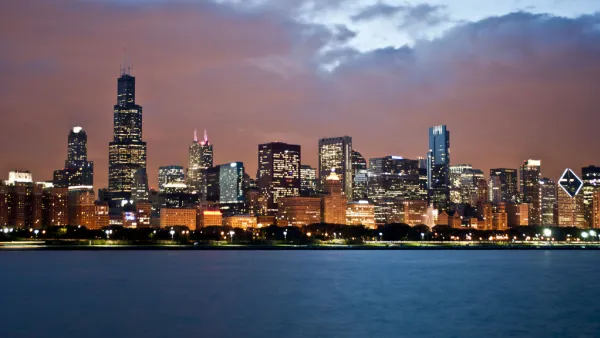
Leaving Chicago
Why are folks fleeing from the city and the state in record numbers? Is domestic migration to blame for the Chicago region's population loss last year of over 6,000 and the state's loss of over 22,000 people?
Safety in Immigrant Numbers
A high rate of poverty, a large population of illegal aliens, and a next-door neighbor to one of the most dangerous cities in the hemisphere, El Paso would seem to be a hotbed of danger. But it's actually one of the safest big cities in America.
New Bike Racks Thwart Theft
A new design for a public bike rack could help prevent crime.

The state-sanctioned urbicide of Austin
People don’t kill cities. Freeways do.

US to reduce Colorado River water deliveries to Mexico
A new Colorado Treaty amendment reduces Mexico’s Colorado River water allocation by 250,000 acre feet.

New Jersey’s second-largest city bans standalone data centers
Jersey City will continue to allow co-location facilities, such as those meant for research institutions that store their own data.

Amtrak not solely to blame for New Jersey commuter rail's unreliability, report finds
A new study from the Garden State Initiative found that NJ Transit’s budget grew 20% across a 4 year period, but reliability declined significantly over the same period.

EPA erases limits on planet-warming pollution from power plants
Under Monday’s plan, power plants would still have some limits on how much mercury, arsenic and other contaminants they can emit.

Phoenix announces new on-demand transit service, more frequent RAPID buses
Both new services will launch in October, and are part of Phoenix's Project Effective Access Solutions for Easing Congestion.

FREE Course: Walkable City 1: Why Walkability?
After describing his path towards focusing on walkability as the essence of good planning, Jeff Speck marches through his five principal reasons for making more walkable places.
Reinventing Malls: Planning Alchemy—Turning Gray Fields Into Gold
The course focuses on the opportunities and imperatives that shape reinvention of mall sites.

Eagle County Government
Harvard University Graduate School of Design
Nashville Planning Department
The Architects Foundation
University of Cincinnati Online
The Pocatello Development Authority
The Urban Renewal Agency of the City of Pocatello
Journal of the American Planning Association