Critics of California's proposed high-speed rail system say that big cities are too spread apart for it to work as well as it has in Europe and Asia. Additionally, Californians will have to learn to adapt to density and public transportation.


"'They're saying it works in Europe, but there are problems comparing (California) with Europe,' said Adrian Moore, vice president of research for the Reason Foundation, which opposes the bond measure. 'It's far more densely developed, and people there were already used to riding trains.'
Transportation experts, including many high-speed rail supporters, say that denser land use - as in Europe and Asia - will be necessary for the system to succeed.
'The high-speed rail system could be far more successful if it's connected with plans to build high density around station sites,' said Martin Wachs, director of the transportation, space and technology program at Rand, a Santa Monica think tank.
Daniels said the authority is already studying ways to encourage denser land use around high-speed rail stations. Van Ark said that usually happens naturally, as high-speed rail makes it possible for people to commute longer distances to work, and proximity to a station becomes valuable."
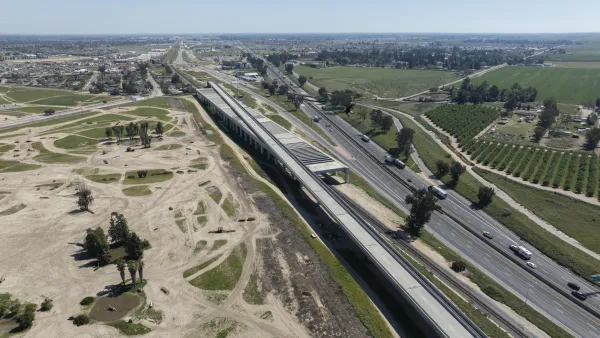
California High-Speed Rail Authority could be broke by the end of 2027
A report from the Office of Inspector General says the authority must borrow against state infusions to stay afloat.
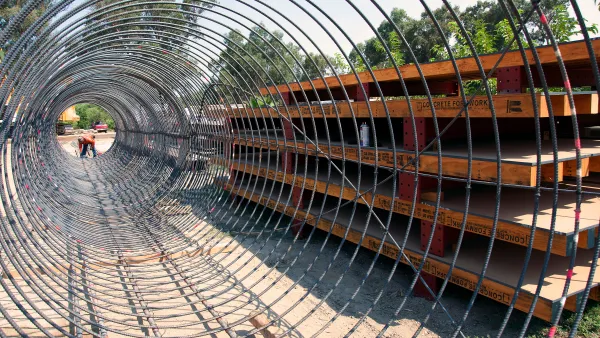
California High Speed Rail to lay first tracks
High Speed Rail Authority officials describe the milestone as "the moment this project truly begins to become a railroad."
TOD Opportunities Around America's First True High-Speed Rail Line
Brightline West hopes to break ground, in anticipation of a 2027 opening. Cities in the Inland Empire and High Desert areas of Southern California are looking to take advantage.

Planetizen Federal Action Tracker
A weekly monitor of how Trump’s orders and actions are impacting planners and planning in America.

California plans to bury El Niño’s downpour
If the state plays its cards right, it may be able to store a billion acre-feet of El Niño’s water in aquifers.

Desperate measures: Advocates weigh draining Lake Powell to fill Colorado River
Draining the reservoir could reduce evaporation losses by a couple hundred thousand acre-feet.

Housing is the top priority of Seattle’s sole new councilmember
Jenks campaigned on building 1,000 new units of affordable housing.

New tax cuts may slash $1.5 billion in funding for Miami transit, public parks
Amendment 3 will save Miami-Dade homeowners $2,700 in 2028.

Arizona, Wisconsin, Pennsylvania hope to finally advance climate goals post-midterms
The three states have spent years under Republican or divided control.

FREE Course: Walkable City 1: Why Walkability?
After describing his path towards focusing on walkability as the essence of good planning, Jeff Speck marches through his five principal reasons for making more walkable places.
Reinventing Malls: Planning Alchemy—Turning Gray Fields Into Gold
The course focuses on the opportunities and imperatives that shape reinvention of mall sites.

City of Rosemead
Rutgers University, Edward J. Bloustein School of Planning and Public Policy
One Hundred Miles
University of Michigan School for Environment and Sustainability (SEAS)
Hunter College, City University of New York (CUNY)
The Architects Foundation
City of Cambridge
Montrose County
The Pocatello Development Authority