Sacramento Bee columnist Daniel Weintraub evaluates the pros and cons of California's $10 billion High Speed Rail Proposition 1A. With state revenues are already expected to be over $10 billion short than projected, he thinks it is a risky measure.


"Would a new train, even a futuristic one, really be a better investment than giving 70,000 more young adults a college education every year? That's the kind of choice that is buried in these single-issue ballot measures but rarely debated.
More than two-thirds of the money to complete the project is supposed to come from sources still not identified. If that money never materializes, or comes up short, the taxpayers would some day be asked to step up with even more billions to finish the line, or risk stopping mid-project with the world's most expensive train to nowhere.
So it's a tough call in tough times. Californians are risk-takers. That trait defines our culture more than any other. This would be a big one. But there is also a risk in doing nothing.
In a few weeks, we'll know whether voters are feeling lucky or whether, with their own wallets pinched and the state government on the brink of financial collapse, they want to save this money for another day."
Read the full story: The Conversation: Transportation salvation or fast train to nowhere?

California High Speed Rail Proposal Heading to Ballot
Rapidly approaching a ballot deadline, CA Gov. Schwarzenegger caved in his pledge to veto any bills sent to him prior to receiving a budget by signing a bill that modernizes the 2002 high speed rail bond. Prop 1A will now appear on the Nov. ballot.
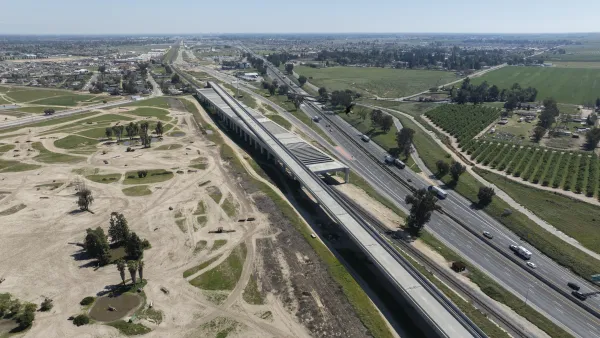
California High-Speed Rail Authority could be broke by the end of 2027
A report from the Office of Inspector General says the authority must borrow against state infusions to stay afloat.
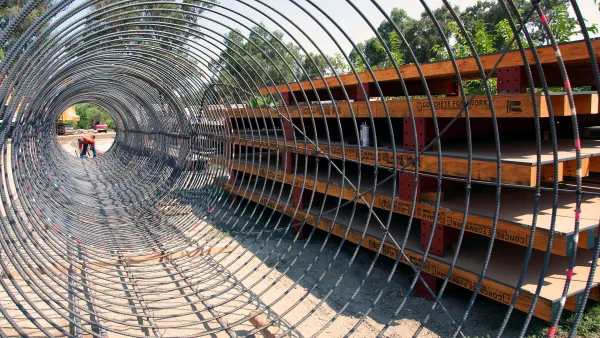
California High Speed Rail to lay first tracks
High Speed Rail Authority officials describe the milestone as "the moment this project truly begins to become a railroad."

Planetizen Federal Action Tracker
A weekly monitor of how Trump’s orders and actions are impacting planners and planning in America.

Amtrak, CN end decades-long dispute with eight-year agreement
The new operating agreement establishes an updated framework for the companies to work together, including processes to resolve disputes.

Judges permit Denver to divert 77,000 acre feet from the Colorado River for reservoir expansion
Overuse and climate change have caused the Colorado River’s water levels to plummet.

NYC DOT wants faster, more permanent street upgrades
The city is examining ways to build more concrete infrastructure without getting entangled in 'decades-long' projects.

'Something we’ve never seen before:' rising utility rates could strain city finances nationwide
Data centers, climate change and other factors have caused utility rates in the United States to increase by 38% since 2020.

Trump to overrule local leaders, lease millions of acres of America’s Pacific Island territories’ seafloors to mining companies
International law says that the Indigenous people of America’s territories have a right to prior and informed consent regarding projects that impact their countries.

FREE Course: Walkable City 1: Why Walkability?
After describing his path towards focusing on walkability as the essence of good planning, Jeff Speck marches through his five principal reasons for making more walkable places.
Reinventing Malls: Planning Alchemy—Turning Gray Fields Into Gold
The course focuses on the opportunities and imperatives that shape reinvention of mall sites.

Harvard University Graduate School of Design
KFH Group Inc.
Greater Baltimore Committee
The Architects Foundation
University of Cincinnati Online
The Pocatello Development Authority
The Urban Renewal Agency of the City of Pocatello