A small suburban Houston town has been planning ahead for growth that's expected to bring its population from just over 700 to nearly 40,000 in the next 15 years.


"The surge of development, including one project planning 6,000 homes, promises to transform this sleepy hamlet into the metropolitan area's next major growth center, with a population that reaches 40,000 or more over the next 10 to 15 years."
"While the timetable could change because of the national credit crisis, the rapid urbanization of Fulshear could rival that of another Fort Bend County town, Sugar Land, whose population increased from about 4,000 in 1980 to about 80,000 today."
"Fulshear's elected leaders are embracing the prospect of growth, but some longtime residents are ambivalent at best."
"Fulshear's leaders have seen the growth coming for years and have been busy preparing for it, adopting regulatory ordinances unusual for such a small town. These measures include sign restrictions, a major thoroughfare plan and an updated subdivision ordinance."
"Preservation of the town's small-town feel has been a cornerstone of these efforts. This goal has been assisted by adjoining landowners who petitioned to be in Fulshear's extraterritorial jurisdiction - the area subject to annexation - rather than Houston's."
Read the full story: Big changes in small town

Houston: The Prophetic City
The Houston story gets a new telling in a recently published book by Stephen Klineberg.

A Look at Houston's Demographic Future
Using the Urban Institute's Mapping America's Futures tool, the Kinder Institute overviews likely racial demographics in Texas and elsewhere by 2030.
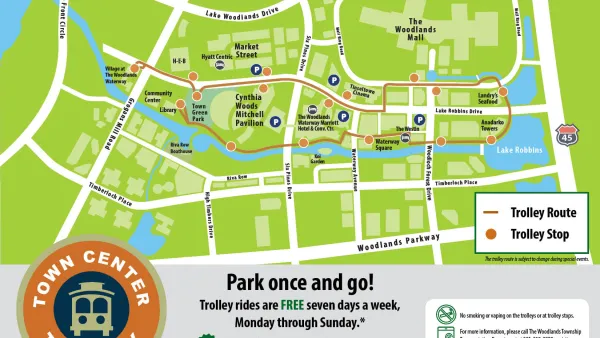
Trolley System Thrives in Houston Suburb
As ridership soars, the "urban circulator" in the Woodlands Township is getting longer routes and more frequent service.

Washington state to charge fee to drivers with fuel-efficient cars
Revenue from the fee will go towards supporting the state’s highways.

Illinois considers spending $1 billion in taxpayer money on data center
A quantum computing campus and data center are currently under construction in Chicago.

Trump to blast ‘hydrocarbon highway’ through ‘world’s longest art gallery’
Environmental and historic preservation groups are suing to stop the project.

NYC, state sue feds over mixed-immigration-status housing assistance rule
The state’s lawsuit argues that the rule change violates the Administrative Procedure Act.

Michigan to turn neighborhood into virtual power plant
Residents will soon be able to divert their excess energy to the grid in exchange for compensation.

Data center, mining project swarm to long-awaited Alaska railroad line
The state-owned railroad approved final plans for the spur line this week; the project is expected to cost $311 million, mostly funded by the federal government

FREE Course: Walkable City 1: Why Walkability?
After describing his path towards focusing on walkability as the essence of good planning, Jeff Speck marches through his five principal reasons for making more walkable places.
Reinventing Malls: Planning Alchemy—Turning Gray Fields Into Gold
The course focuses on the opportunities and imperatives that shape reinvention of mall sites.

City of Charlotte
City of Rosemead
Rutgers University, Edward J. Bloustein School of Planning and Public Policy
University of Michigan School for Environment and Sustainability (SEAS)
Hunter College, City University of New York (CUNY)
The Architects Foundation
University District Partnership