Despite the $700 billion financial bailout plan, the suburbs will continue to lose population and value, according to Peter Katz. He says it's time for the government to prevent suburban development that is only doomed to fail.


"The pattern across the continent is fairly consistent: Dwellings within walkable neighborhoods, close to transit, shopping and places of entertainment, are holding their own in terms of price and value."
"By contrast, the future appears far bleaker for the endless rows of foreclosed homes out on the urban fringes - the 'buy 'til you qualify' subdivisions located half a gas tank away from most everywhere. Christopher Leinberger, in his Atlantic article 'The Next Slum,' says there are clear signals that such places 'will become magnets for poverty, crime and social dysfunction.'"
"Maybe it's time, even as the billions of bailout dollars flow, for official Washington to get tough. It's emerging as lender of last resort, asset manager for the wounded American taxpayer, assuming the responsibility for thousands of toxic mortgages on property that more diligent local planners might never have allowed to be built. So why could Washington not advocate - maybe even require as a price for the potential subsidies and loan insurance it may offer - compliance with planning rules aimed at promoting more economically robust, resource-efficient communities?"
Read the full story: Will Rescue Plan Simply Serve Sprawl?
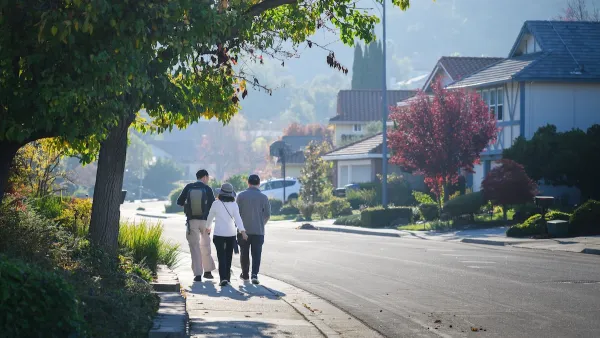
Will sprawl save California?
California residents will vote on Proposition 45 in November, which would make it easier to build large housing developments on the outskirts of the state’s cities.
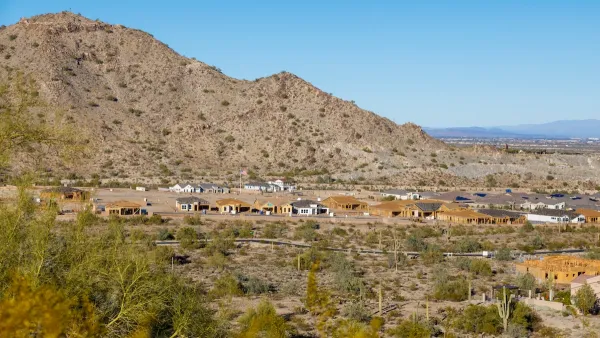
Arizona Overrides Moratorium Imposed due to Water Crisis, Approves up to 60K New Homes
A newly created legal process allows development to proceed if builders agree to bring in renewable water sources and reduce their groundwater use by 25%.
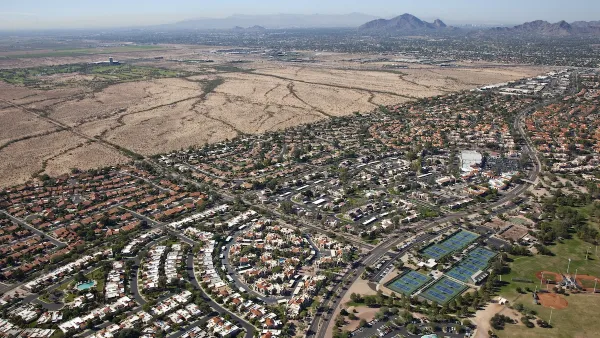
Nearly Half a Million New Arizona Homes Halted Due to Water Crisis
The Arizona Department of Water Resources has put a moratorium on new water supply permits, making the future of planned residential developments uncertain.

Planetizen Federal Action Tracker
A weekly monitor of how Trump’s orders and actions are impacting planners and planning in America.

Eastern Nebraska is running out of electricity
Data centers and electrification are straining eastern Nebraska’s grid, throttling economic development.

Study reveals best places in the U.S. for cycling, walking
New research from Streetlight Data examines bicycle and pedestrian miles per capita in the 100 largest U.S. cities by population.

Next-generation nuclear reactors are coming to Texas
The reactors will not require towering containment structures thanks to new safety features.

California distributes $1.3 billion to prevent transit service cuts, bolster projects
Twenty-eight projects across California received a portion of the funding.

Pennsylvania Democrats have 15 affordability, clean energy bills for flipped state Senate
Bills in consideration include a bill supporting geothermal energy and a bill supporting solar on warehouses.

FREE Course: Walkable City 1: Why Walkability?
After describing his path towards focusing on walkability as the essence of good planning, Jeff Speck marches through his five principal reasons for making more walkable places.
Reinventing Malls: Planning Alchemy—Turning Gray Fields Into Gold
The course focuses on the opportunities and imperatives that shape reinvention of mall sites.

City of Charlotte
City of Rosemead
Rutgers University, Edward J. Bloustein School of Planning and Public Policy
University of Michigan School for Environment and Sustainability (SEAS)
Hunter College, City University of New York (CUNY)
The Architects Foundation
City of Cambridge
The Pocatello Development Authority
The Urban Renewal Agency of the City of Pocatello