The $700 billion bailout bill includes federal tax benefits for people who commute by bike.


"Starting in January, workers who use two-wheelers as their primary transportation mode to get to and from work will be eligible for a $20-a-month, tax-free reimbursement from their employers for bicycle-related expenses. In return, employers will be able to deduct the expense from their federal taxes.
"It significantly legitimizes bicycling and elevates it to a credible commute mode, like riding a bus or train," said Andy Thornley, program director for the San Francisco Bicycle Coalition.
The money could be used to purchase, store, maintain or repair bikes that are used for a substantial portion of an employee's commute.
Bike advocates have been trying for seven years to get such a provision passed in Washington, but came up short until Congress rushed through the Wall Street bailout package last week and lawmakers squeezed in pet projects. The bicycle benefit was championed by members of the Oregon delegation."
Thanks to rob bregof
Read the full story: Bailout gives tax break to bicycle commuters
Why I Gave Up the Bus...For a Bike
In August, I moved into a high density apartment complex just 1.5 miles from my office and a five minute walk to a bus stop. One of the central advantages of the building's location was its access to alternative transportation modes. While I could park my car for "free" (the real cost is built into the lease), I was interested in keeping it parked as much as possible. Now, after nearly three months of experimentation, I'm ready to give up the bus, and the reasons are central to understanding the future of transit in the US.
Bike Buddies Turn Commute Into Workout
T.J. Kelly was finding it difficult to squeeze in exercise, and looking at his rising commute costs. A new co-worker helped him turn his commute into a workout.
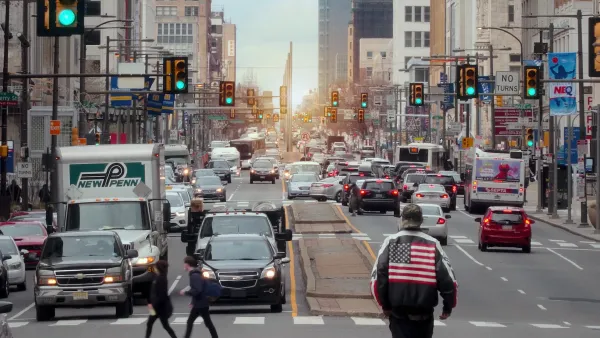
US workers spend nearly an hour a day commuting
High housing costs and return-to-office policies are forcing more American workers to live farther from work, pushing the average daily commute time to nearly an hour.

Planetizen Federal Action Tracker
A weekly monitor of how Trump’s orders and actions are impacting planners and planning in America.

California plans to bury El Niño’s downpour
If the state plays its cards right, it may be able to store a billion acre-feet of El Niño’s water in aquifers.

Desperate measures: Advocates weigh draining Lake Powell to fill Colorado River
Draining the reservoir could reduce evaporation losses by a couple hundred thousand acre-feet.

Chicago voters approve permanent festival grounds, penalty for vacant property owners
Currently, major summer and fall festivals take over public parks for weeks at a time, drawing criticism from nearby residents

NYC votes to cut outdoor dining red tape, speed up permitting
New York City also voted to allow the Department of Transportation to begin work on urgent projects before notifying elected officials.

California appears to reject Prop. 45
The proposition would have expanded the projects that qualify for a streamlined environmental review, effectively paring down the California Environmental Quality Act.

FREE Course: Walkable City 1: Why Walkability?
After describing his path towards focusing on walkability as the essence of good planning, Jeff Speck marches through his five principal reasons for making more walkable places.
Reinventing Malls: Planning Alchemy—Turning Gray Fields Into Gold
The course focuses on the opportunities and imperatives that shape reinvention of mall sites.

City of Rosemead
Rutgers University, Edward J. Bloustein School of Planning and Public Policy
One Hundred Miles
Hunter College, City University of New York (CUNY)
The Architects Foundation
University of Cincinnati Online
City of Cambridge
Montrose County
The Pocatello Development Authority