Frequent Rider Miles, on-line tickets and on-board wi-fi are but a few of the amenities and cost cutting strategies that are attracting riders to inter-city bus travel.


"If airline deregulation spawned a generation of low-cost carriers, the era of $100-a-barrel oil is giving rise to a new breed of discount bus operators. And unlike discount airlines, low-cost bus lines are thriving. While overall bus travel continues to grow in the mid-single digits, discount operators such as BoltBus (a joint venture of Greyhound Lines and Peter Pan Bus Lines), DC2NY, Vamoose, and Coach USA's Megabus are enjoying heady growth by offering cheap, no-frills travel."
"It's not just high fuel prices-it's the hassle factor at the airports that has left many fliers disenchanted," says Joseph P. Schwieterman, a professor of transportation at DePaul University. "Travelers who wouldn't have given a thought to bus travel are now stepping on board."
"For bargain bus lines, the key to success is their ability to keep costs to a minimum. BoltBus, for instance, picks up passengers curbside, sparing it the expense of leasing space at a terminal. And it only sells tickets online, which eliminates the cost of employing ticket agents. (Roughly 90% of Greyhound's tickets are sold either by phone or at a terminal.) BoltBus is also building business with a frequent-rider program"
From "Smaller Airlines Get Battered This Time":
"By contrast (to legacy airlines that can still rely on business class travelers), executives at the discounters-one of whom boasted that he had stolen customers not from the big airlines but from bus operators like Greyhound-have seen demand fall as some of their most cost-conscious clientele head back to the bus."
Read the full story: Suddenly, It's Cool to Take the Bus


Florida Could See Commercial Air Taxis by End of Year
The state wants to be the first in the nation to build infrastructure for commercial electric vertical take-off and landing aircraft (eVTOL).
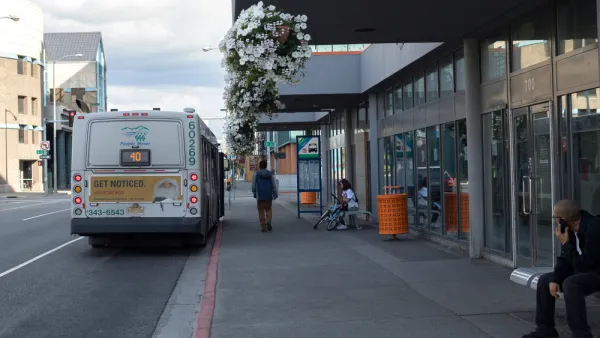
Anchorage Bus Depot to Reopen
After a four-year closure, a downtown Anchorage transit center will once again provide indoor waiting areas and services for bus travelers.

Chicago Bus Travelers Could Lose Downtown Terminal — and Winter is Coming
As the loss of intercity bus services and stations continues, Chicago could become the largest city in the developed world without a major downtown bus terminal.

Planetizen Federal Action Tracker
A weekly monitor of how Trump’s orders and actions are impacting planners and planning in America.

The state-sanctioned urbicide of Austin
People don’t kill cities. Freeways do.

US to reduce Colorado River water deliveries to Mexico
A new Colorado Treaty amendment reduces Mexico’s Colorado River water allocation by 250,000 acre feet.

Nation's most wind-powered state turns to coal as data centers increase energy demand
For the first time in decades, Iowa has increased its generation of coal power.

NYC cools commuters with city's first rain garden above a bus stop
New York City officials say the plants in the rain garden can absorb 16 gallons of rainwater during heavy storms.

Brightline West’s future may rely on $6 billion federal loan
The company has until Nov. 2 to make a $400 million equity investment into its proposed high-speed rail line.

FREE Course: Walkable City 1: Why Walkability?
After describing his path towards focusing on walkability as the essence of good planning, Jeff Speck marches through his five principal reasons for making more walkable places.
Reinventing Malls: Planning Alchemy—Turning Gray Fields Into Gold
The course focuses on the opportunities and imperatives that shape reinvention of mall sites.

Eagle County Government
Harvard University Graduate School of Design
Nashville Planning Department
The Architects Foundation
University of Cincinnati Online
The Pocatello Development Authority
The Urban Renewal Agency of the City of Pocatello
Journal of the American Planning Association