An Albany newspaper takes a look at cycling in the Capital District: cycling is up, and advocacy groups are working to take advantage of it.


"The average American spends an hour each day in a car, and that number rises to one and a half hours a day for people ages 35 to 44. Even though 41 percent of trips are less than two miles long, Americans use cars to carry out the large majority of them, according to a 2003 study. All of this motorized transport contributes to health problems that cost the country $22 billion a year, according to the League of American Bicyclists. In addition, driving has caused a host of social and environmental problems, from air pollution to suburban sprawl. Claire Nolan, a member of the Albany Bicycle Coalition and New York Bicycling Coalition, says, 'The automobile is only 100 years old, and in those 100 years, it's pretty much destroyed everything.'"
"Among the many advantages touted by cycling advocates, they report that it saves them money. "I'm certainly not as impacted by the increase in gas prices," says Joshua Poppel, the executive director of NYBC. A cycle commuter for the past eight years, he says he can go at least six weeks without filling his car's gas tank."
Albany, and its sister cities, despite housing a number of cycle-friendly nonprofits, has been slow to adopt pro-bike measures. For many, bad roads are the main inhibitor, although concerns about safety and suburban sprawl also prevent many from cycling.
Thanks to Franny Ritchie
Simple Cycling Solutions
Now that the weather in Los Angeles has gone from pleasant to perfect with the subtle advent of spring, I've been spending more time risking my life atop my bicycle as I wend my way to meetings and errands. As a faithful urbanist I have little trouble convincing myself of cycling's merits, which, as former California State Health Officer Dr. Richard Jackson likes to say, can "improve your life span, lower your blood pressure, make you better looking, improve your sex life, and save you money." Sounds good to me.
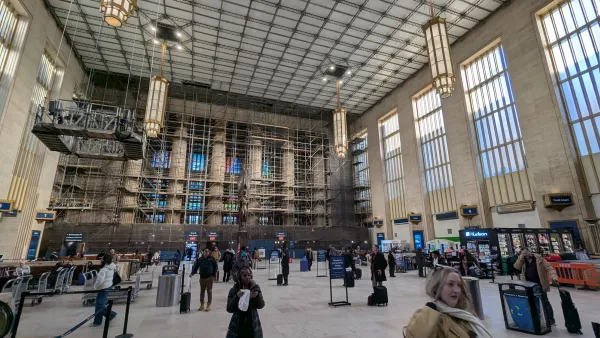
Pennsylvania 12-year transportation plan commits $13B for transit
The state's new mid-range transportation strategy includes nearly $17 billion for roads and bridges and $367 million for multimodal projects.
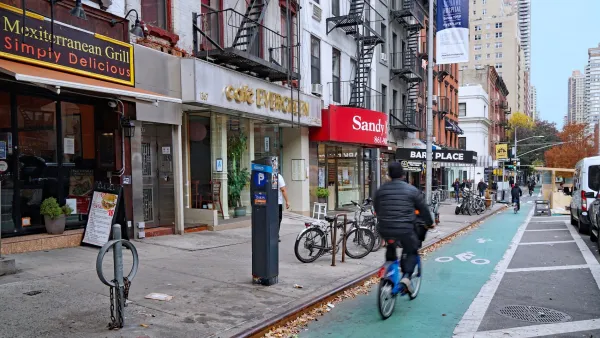
Study: Protected bike lanes increase Citi Bike rides by nearly 400 rides a month
An analysis of millions of NYC bike share rides reveals that only protected bike lanes have a 'statistically significant' increase in ridership.

Planetizen Federal Action Tracker
A weekly monitor of how Trump’s orders and actions are impacting planners and planning in America.

California plans to bury El Niño’s downpour
If the state plays its cards right, it may be able to store a billion acre-feet of El Niño’s water in aquifers.

Desperate measures: Advocates weigh draining Lake Powell to fill Colorado River
Draining the reservoir could reduce evaporation losses by a couple hundred thousand acre-feet.

US buildings threatened, destroyed by fires set to triple by 2060
Researchers found a high fire risk for socioeconomically vulnerable neighborhoods in the American West.

LA residents may be allowed to paint their own crosswalks
Councilwoman Katy Yaroslavsky put out a motion instructing the Los Angeles Department of Public Transportation to study the feasibility of allowing volunteers to paint crosswalks.

Dallas moves to overhaul its zoning code
The city's zoning reform will allow more multi-family and mixed-use developments.

FREE Course: Walkable City 1: Why Walkability?
After describing his path towards focusing on walkability as the essence of good planning, Jeff Speck marches through his five principal reasons for making more walkable places.
Reinventing Malls: Planning Alchemy—Turning Gray Fields Into Gold
The course focuses on the opportunities and imperatives that shape reinvention of mall sites.

City of Rosemead
Rutgers University, Edward J. Bloustein School of Planning and Public Policy
One Hundred Miles
Hunter College, City University of New York (CUNY)
The Architects Foundation
University of Cincinnati Online
City of Cambridge
Montrose County
The Pocatello Development Authority