Mexico is moving forward with plans to construct a large international shipping port in Baja California -- an attempt to rival the Los Angeles-Long Beach port powerhouse.


"Mexico's government is setting sail with the largest infrastructure project in the nation's history, a $4-billion seaport that it hopes will one day rival those of Los Angeles and Long Beach."
"Plans call for the construction of a massive port in the tiny coastal village of Punta Colonet, about 150 miles south of Tijuana, along with new rail lines to whisk Asian-made goods north to the United States. Mexico's aim is to snatch some Pacific cargo traffic from Southern California's ports, whose growth is constrained by urban development and environmental concerns."
"Punta Colonet is expected to have a capacity of 2 million shipping containers annually when it opens in 2014, Mexico's transportation secretariat told The Times But officials envision it ultimately handling five times that amount. Last year, the ports of L.A. and Long Beach handled 15.7 million containers combined."
"The massive development is to be privately funded, with the first phase estimated to cost $4 billion to $5 billion. The government is expected to award the 45-year concession in 2009."
Read the full story: Mexico plans huge Baja port for U.S. trade

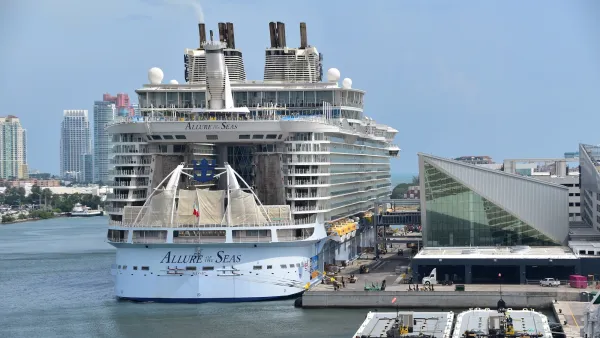
Miami Considers Airport-to-Port Train to Ease Cruise Ship Traffic
Miami’s port is one of the world’s busiest cruise ship terminals.

Planetizen’s Top Urban Planning Books of 2025
How thoughtful deregulation could unlock a housing and infrastructure boom, the social histories that lie behind a globalizing economy, and the growing role of artificial intelligence in planning.

AI and 5G Could Advance Port Automation
A vision for the future of automated ports with AI and 5G: harnessing technology for enhanced efficiency, reliability, and safety.

Planetizen Federal Action Tracker
A weekly monitor of how Trump’s orders and actions are impacting planners and planning in America.

California plans to bury El Niño’s downpour
If the state plays its cards right, it may be able to store a billion acre-feet of El Niño’s water in aquifers.

Chicago breaks ground on $3 billion megadevelopment
The new neighborhood, titled Foundry Park, will one day host 3,700 residences.

California High-Speed Rail Authority CEO resigns after $600,000 scandal
Under Ian Choudri, the authority used taxpayer dollars to fund first class flights and trips to nightclubs.

Want to study the Missouri River? Soon, you may need unanimous approval from 10 states
Legislation would require 10 governors’ permission to study or build projects moving water outside the basin.

Desperate measures: Advocates weigh draining Lake Powell to fill Colorado River
Draining the reservoir could reduce evaporation losses by a couple hundred thousand acre-feet.

FREE Course: Walkable City 1: Why Walkability?
After describing his path towards focusing on walkability as the essence of good planning, Jeff Speck marches through his five principal reasons for making more walkable places.
Reinventing Malls: Planning Alchemy—Turning Gray Fields Into Gold
The course focuses on the opportunities and imperatives that shape reinvention of mall sites.

City of Rosemead
Rutgers University, Edward J. Bloustein School of Planning and Public Policy
One Hundred Miles
Hunter College, City University of New York (CUNY)
The Architects Foundation
University of Cincinnati Online
City of Cambridge
Montrose County
The Pocatello Development Authority